
London Design Festival 2025 returns this September with an ambitious programme of installations, exhibitions, and experiences that celebrate design’s power to transform spaces and spark meaningful conversations. This year’s Festival showcases how contemporary design intersects with technology, sustainability, and our shared cultural heritage, bringing design directly into the public realm with Landmark Projects at Trafalgar Square and the Southbank Centre that invite all Londoners and visitors to engage with innovative design in the heart of the city.
The 2025 Festival is supported by Bloomberg Philanthropies, with Bloomberg Connects being the Festival’s official digital guide. The free mobile guide will feature content exclusive to Connects: expert commentary, video highlights and curated routes across the city.
Landmark projects
WHAT NELSON SEES BY PAUL COCKSEDGE SUPPORTED BY GOOGLE ARTS AND CULTURE
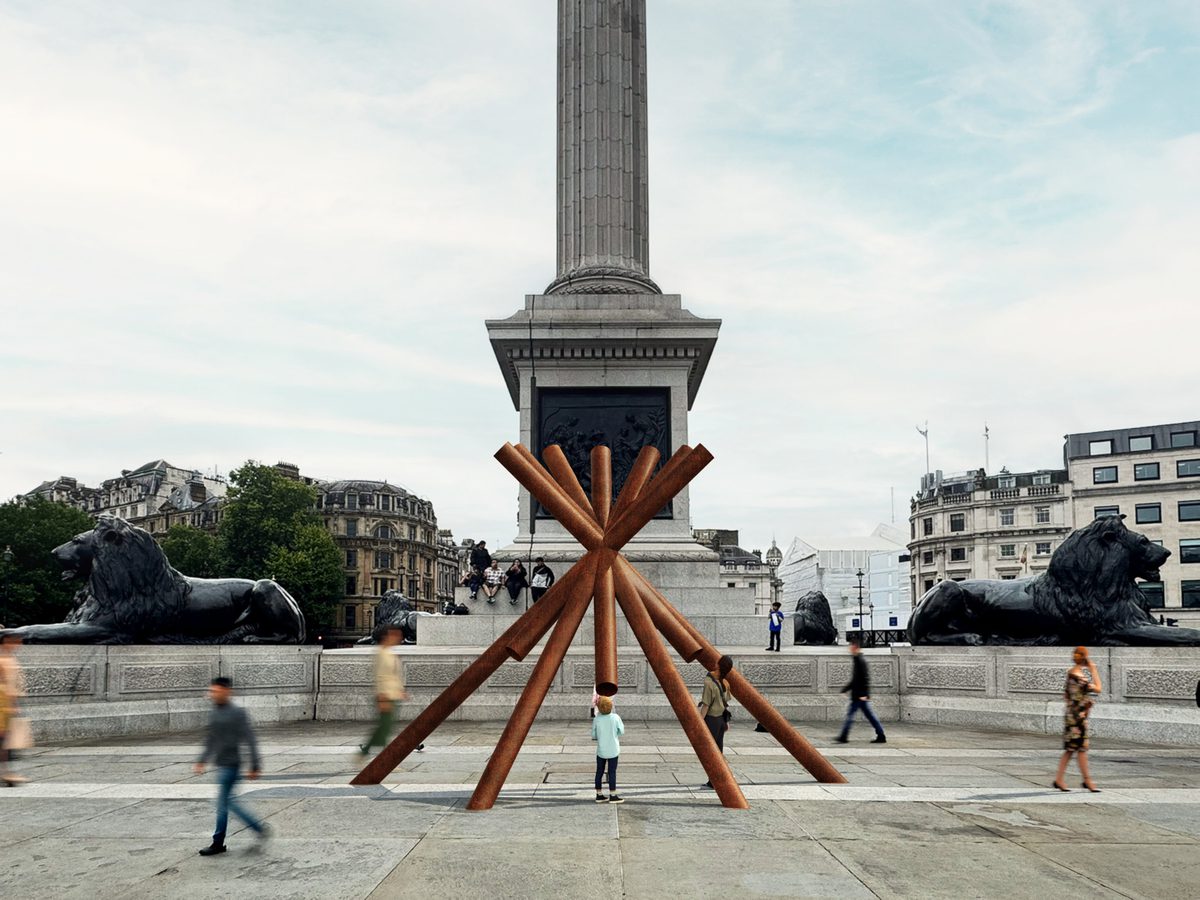
Taking over Trafalgar Square, one of London’s best-known landmarks, What Nelson Sees by Paul Cocksedge in collaboration with Google Arts and Culture offers visitors an unprecedented opportunity to experience London from Nelson’s vantage point atop his column, revealing perspectives of the city never before accessible to the public. Born from the designer’s lifelong curiosity about what Admiral Nelson witnesses from his elevated perch, this ambitious public installation represents Cocksedge’s attempt to answer a question that has captivated him as a Londoner: teleporting viewers fifty metres skyward to discover a view that has been hidden for nearly two centuries.
The sculpture comprises a series of intersecting tubes that form a striking freestanding structure. These lines form telescopic viewing portals, inviting visitors to peer through and discover London’s skyline from Nelson’s perspective. The installation creates both a compelling sculptural form and functional portals that allow the public to gaze through to this unique, elevated viewpoint. The weathered texture of the metal serves as a reference to Britain’s maritime heritage and industrial power. When audiences peer through, they will see what Nelson sees. Visitors will be able to rewind time to experience how London has evolved over the past century, the changing forms of transport from cars to horse-drawn carriages, from streetlights to gas lamps and shifting fashions. The view then fast-forwards and a moving vignette visualises a speculative future: Will London become more self sufficient and increase local food production? Will streets adapt to a hotter climate? Will more areas be pedestrianised? Through these vignettes, Cocksedge invites audiences to reflect on London’s past, present and possible future.
Brought to life with Flow, Google’s AI filmmaking tool powered by Veo, these moving vignettes aim to capture the essence of London as a perpetual melting pot and a city of relentless energy, creativity, and reinvention that has continuously transformed itself while maintaining its distinctive character and historic significance.
What Nelson Sees uses one of London’s most enduring monuments, a column that has stood for almost 200 years, as the anchor for a conversation about the next 200 years. It connects the sweep of London’s history to the possibilities and uncertainties of its future. At its heart it is about perspective, about looking out from where Nelson stands and seeing London: past, present, and future.
Paul Cocksedge, said: “As a lifelong Londoner, I’ve always gazed up at Nelson and wondered what he sees. This piece combines one of the city’s best-known landmarks with artificial intelligence, merging timelines and bringing history into conversation with contemporary technology. Working with Google’s AI filmmaking tools, I was able to bring to life the essence of the past and visualize a possible future. I hope this invites reflection and sparks conversation on how cutting-edge technology will shape culture, design, and society as our city evolves.”
BEACON BY LEE BROOM
SUPPORTED AND PRODUCED BY BROKIS AND MATERIALS ASSEMBLE MADE POSSIBLE WITH THE SUPPORT OF THE SOUTHBANK CENTRE
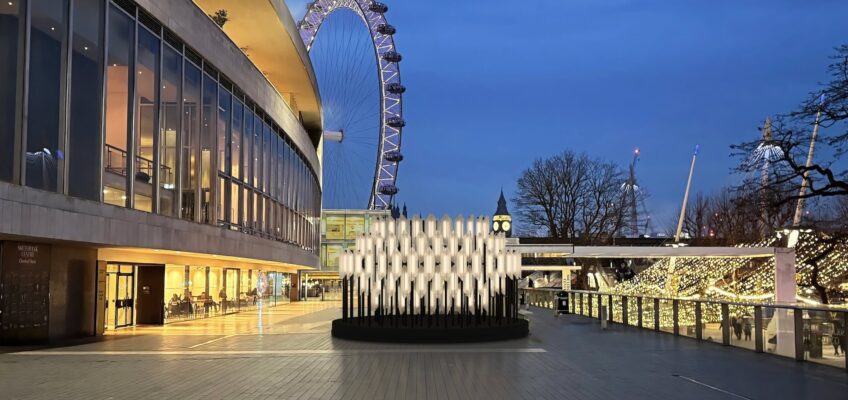
Beacon is a monumental sculptural lighting installation designed by Lee Broom, supported and produced by Brokis and Materials Assemble. Positioned at the entrance of the Southbank Centre’s Royal Festival Hall, the installation draws inspiration from the area’s iconic Brutalist architecture and the legacy of the 1951 Festival of Britain, once heralded as a „beacon of change.” Broom has conceived a large-scale, site-specific sculpture that both honours and reimagines the cultural and architectural language of the South Bank. Standing as a contemporary tribute to one of London’s most historically significant public spaces, Beacon offers a powerful symbol of both the past and the future.
As a major piece of public art, Beacon has been conceived not only as a design installation but as a shared experience in the public realm, one that is open, accessible, and intended for all. Its illuminated structure will be visible from across the Thames, from Waterloo and Golden Jubilee Bridges, and from the Embankment, casting its presence across the city and offering a moment of light and reflection to all who encounter it, whether by design or by chance.
One of Beacon’s most captivating features will be its dynamic choreography of light. As Big Ben strikes the hour across the river, the installation’s illuminated shades will come to life. Beginning with a slow, poetic pulse the light show will build in tempo to a dramatic crescendo. This moment not only animates the sculpture but also weaves it into the fabric of the city, connecting its architectural and cultural references with London’s sense of time, history, and presence, and inviting passers by to share in an immersive experience that is both rooted in place and alive with movement.
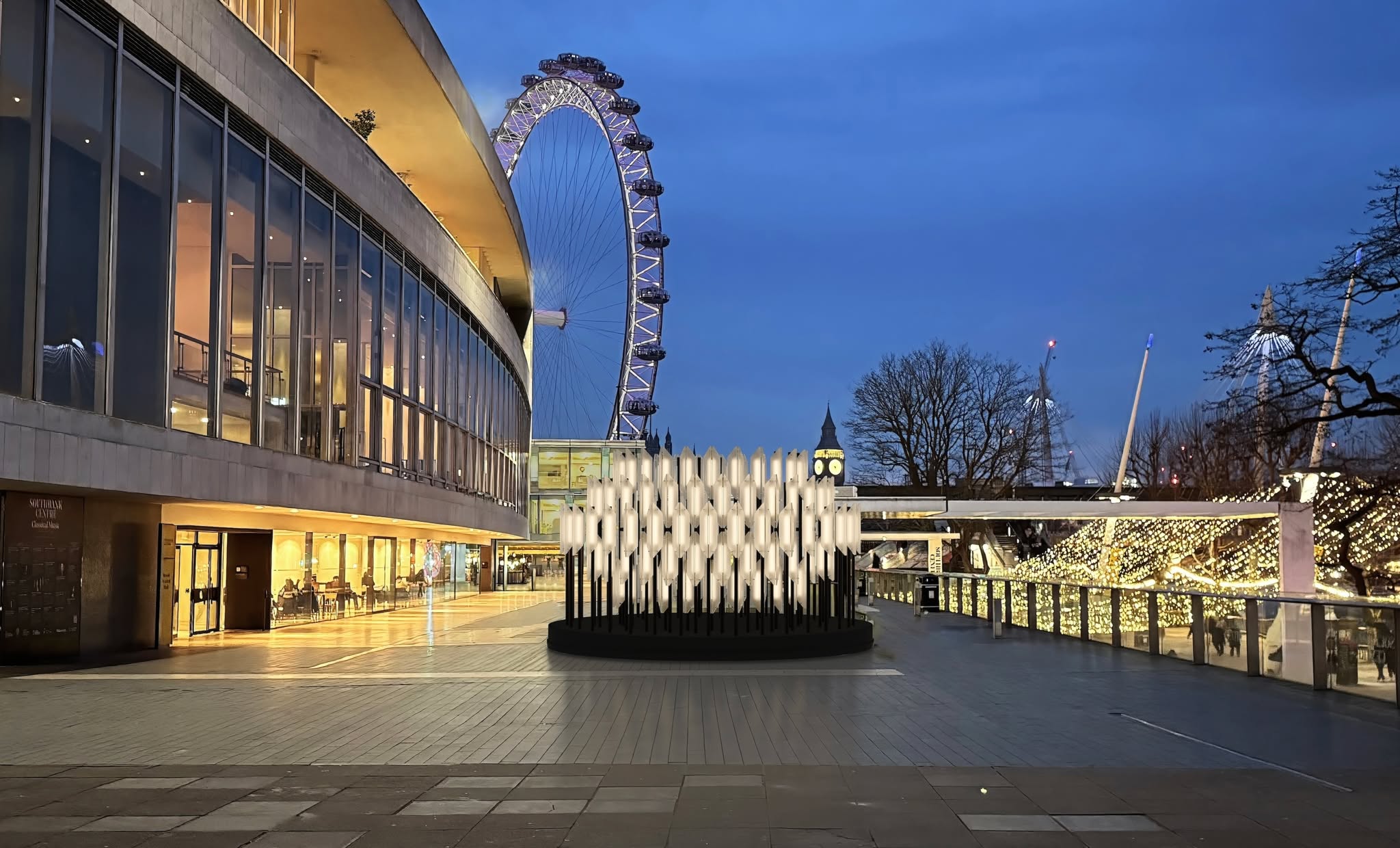
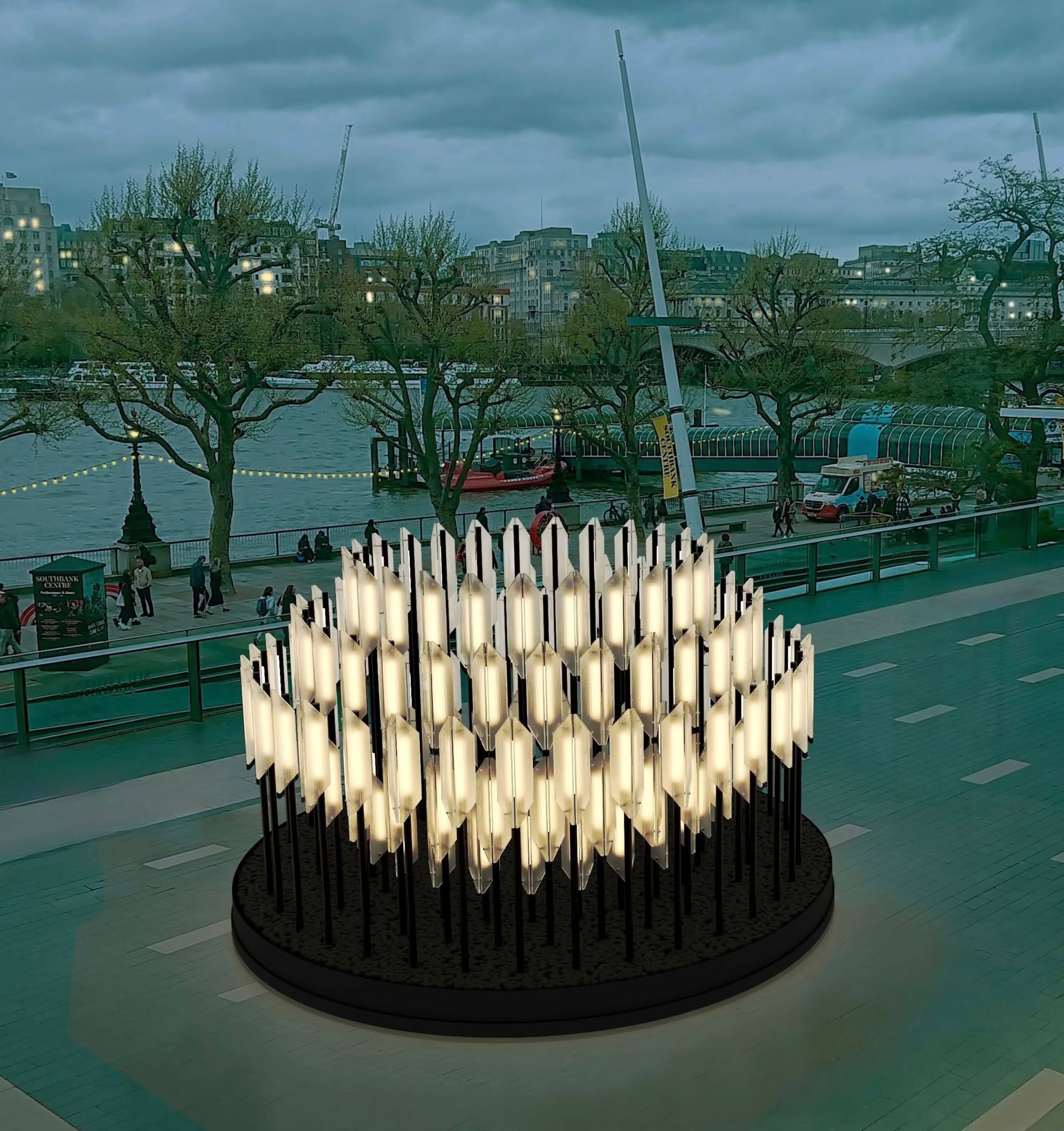
Composed of multiple black lamposts, each crowned with an illuminated recycled glass shade, Beacon takes its visual cue from the Victorian Dolphin Street Lamps designed by George John Vulliamy in 1870, an enduring fixture of the Thames Embankment. The installation’s form and rhythm reinterprets these classical designs through a contemporary lens, fusing them with the postmodern architecture of the Royal Festival Hall and the brutalist materiality of the Hayward Gallery, while collectively resembling a vast sculptural chandelier that appears to float at the building’s entrance.
Each of the glass elements has been produced from recycled glass at Brokis’ renowned factory in the Czech Republic using a special fusing technology developed to upcycle discarded glass fragments. The textured surface of the glass replicates the imprint of Baltic Pine, a detail famously cast into the concrete walls of the Hayward Gallery, reinterpreting one of the South Bank’s most distinctive architectural features using a material rooted in renewal.
With a focus on sustainability, Beacon has been developed in partnership with Materials Assemble, a pioneering materials sourcing company dedicated to promoting eco-friendly materials and responsible design practices. The installation has been engineered for longevity and reuse. Once deinstalled, each part has been designed to be repurposed into standalone lighting fixtures or combined to form pendant chandeliers, with a portion of the proceeds from their sale being donated to charity, ensuring that Beacon lives on beyond its original setting.
Lee Broom, said: “It is a real honour to be creating my first Landmark Project for the London Design Festival, particularly as my very first collection launched during the Festival back in 2007. In many ways, this project feels like a full-circle moment. I’ve always been hugely inspired by London and its architecture, especially the city’s Brutalist and modernist buildings, and having lived here most of my life, the Southbank Centre has long been a place of creative resonance for me. There were so many architectural and cultural references I wanted to weave into Beacon. It is a tribute to both the history and the future of this iconic location. Working with the incredible artisans at Brokis Glass has elevated this project; their understanding of light and form brought this vision to life with extraordinary sensitivity. I hope the installation evokes a sense of spectacle, but also stirs something deeper: an emotional connection to the power of light, and to the spirit of the Southbank itself.”
Beacon will remain on display at the Southbank Centre, and will be exhibited as part of Winter Light 2025.
ABOUT LONDON DESIGN FESTIVAL
Established in 2003 by Sir John Sorrell CBE and Ben Evans CBE, London Design Festival celebrates and promotes London as the design capital of the world. London Design Festival has since earned the reputation as a key calendar moment of London’s autumn creative season, alongside London Fashion Week, Frieze Art Fair and the London Film Festival, attracting the greatest thinkers, practitioners, retailers and educators to the capital, in a citywide celebration.

