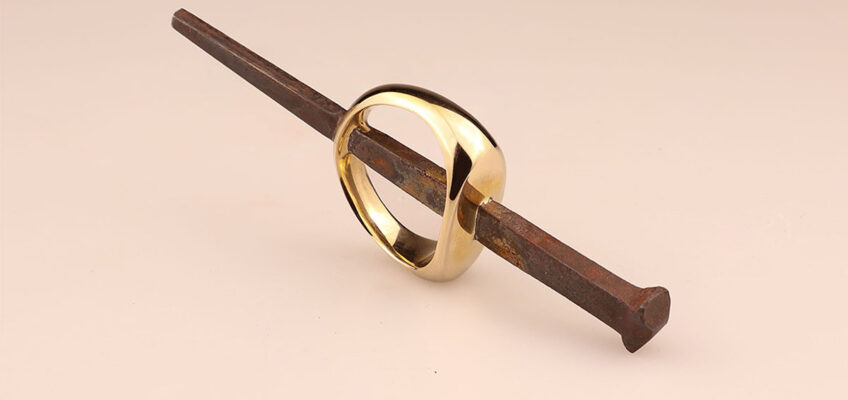
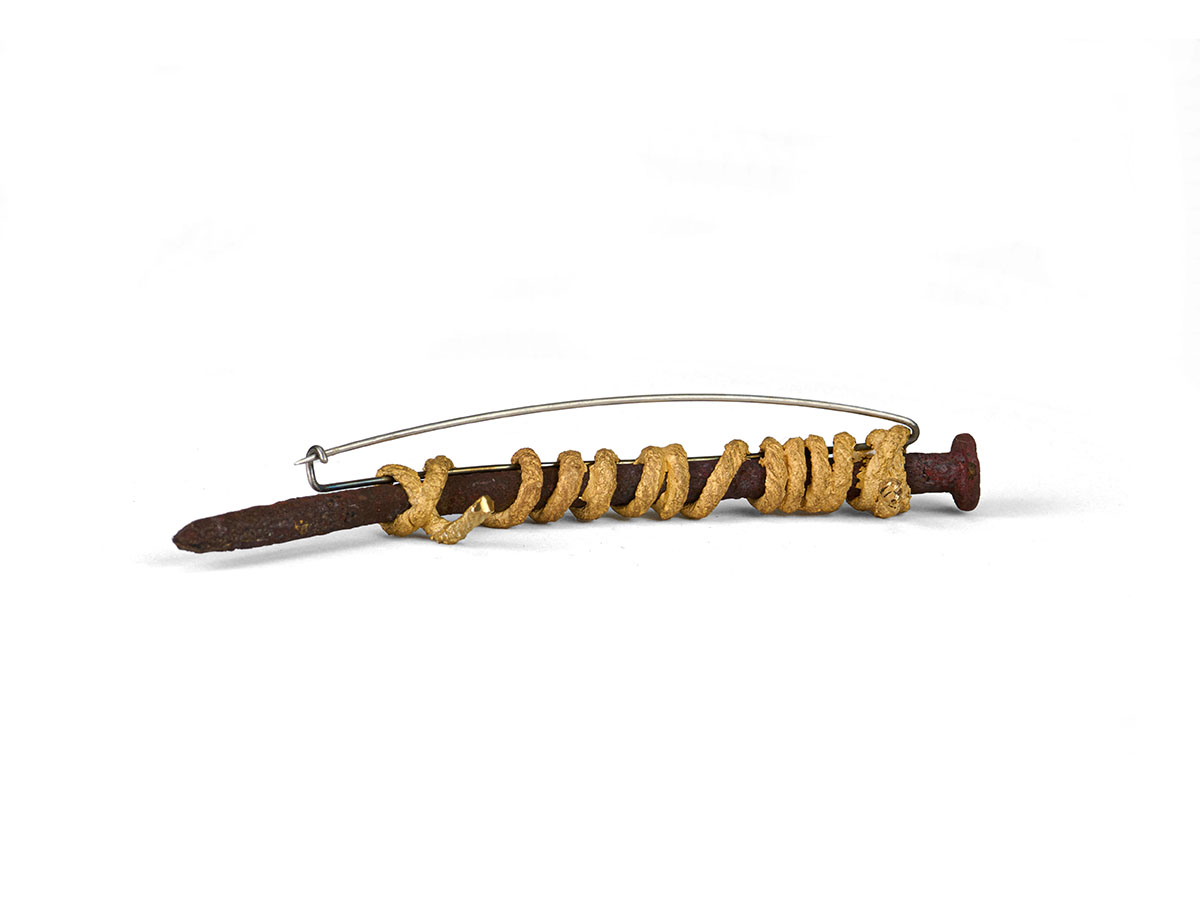
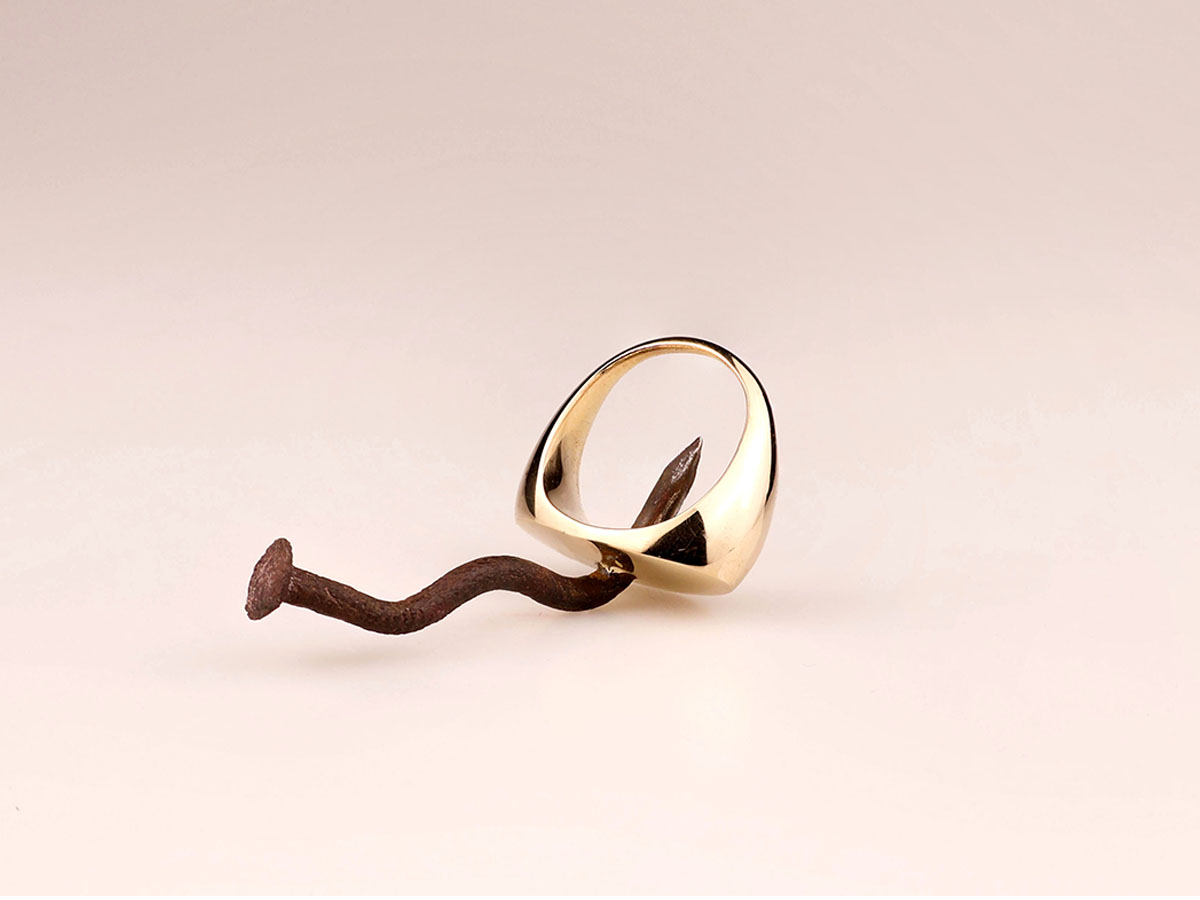
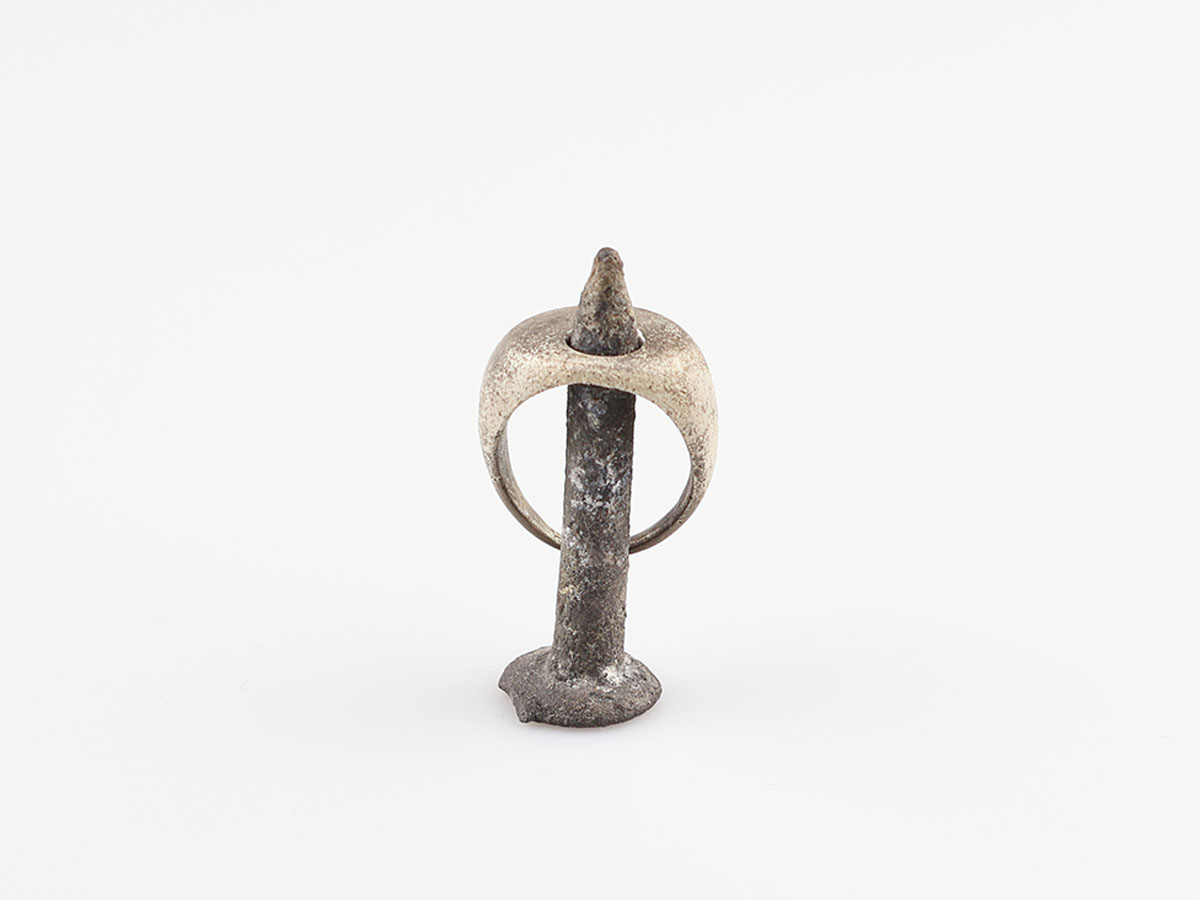
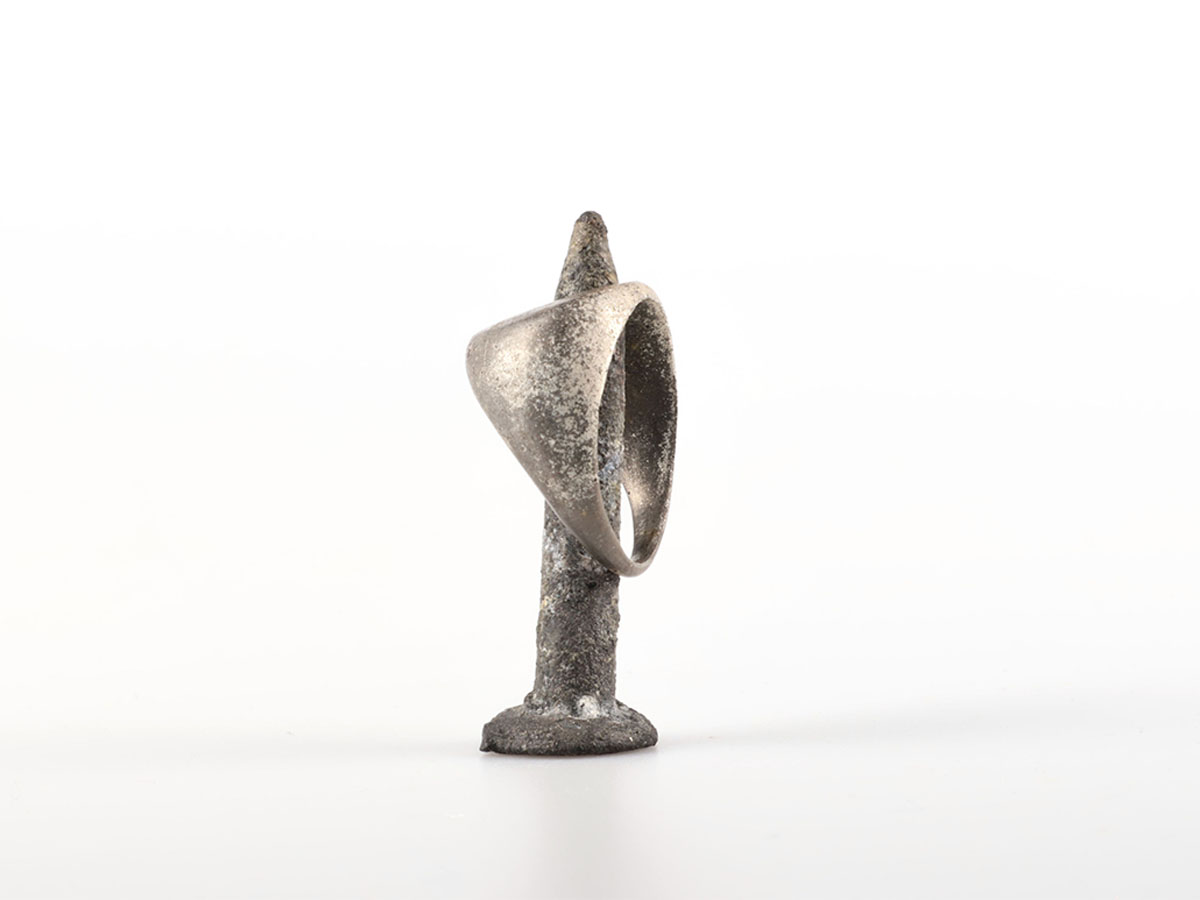
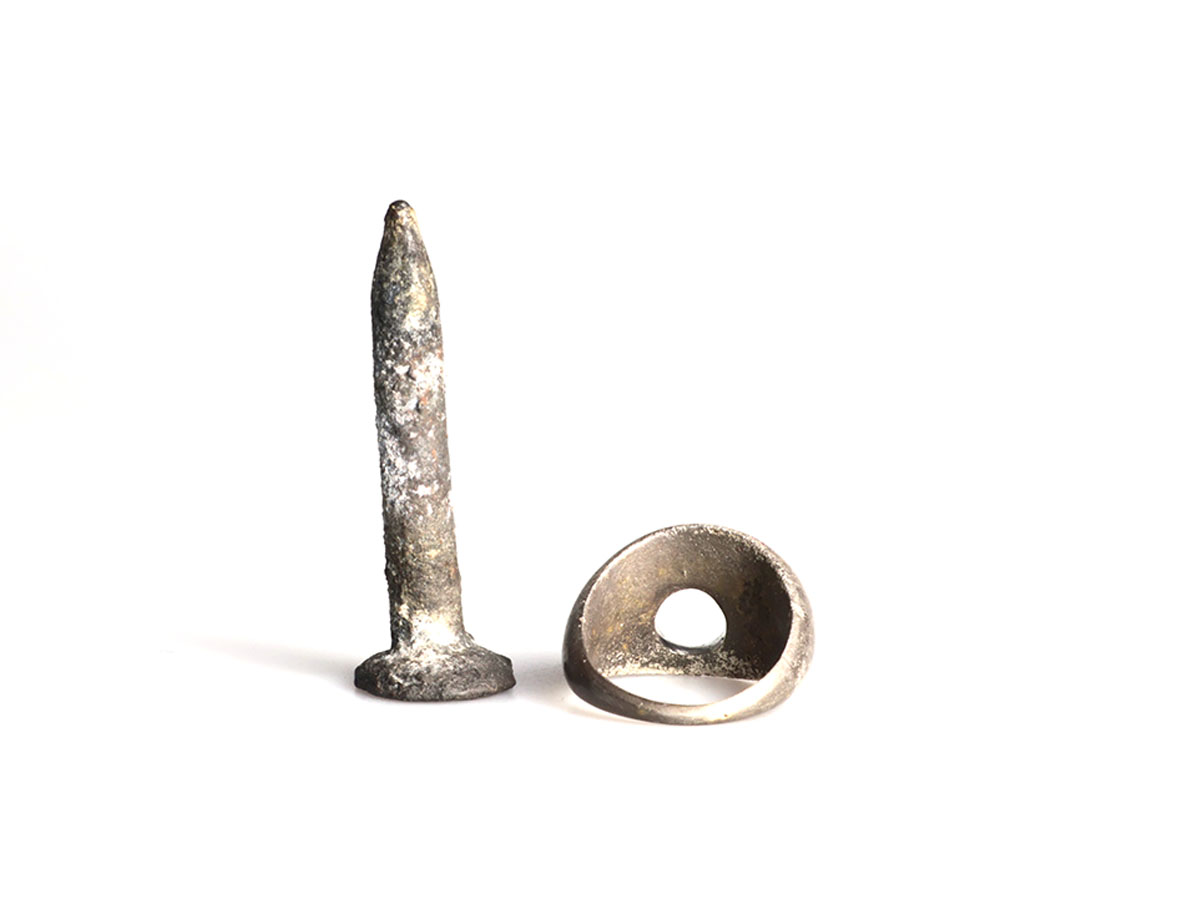
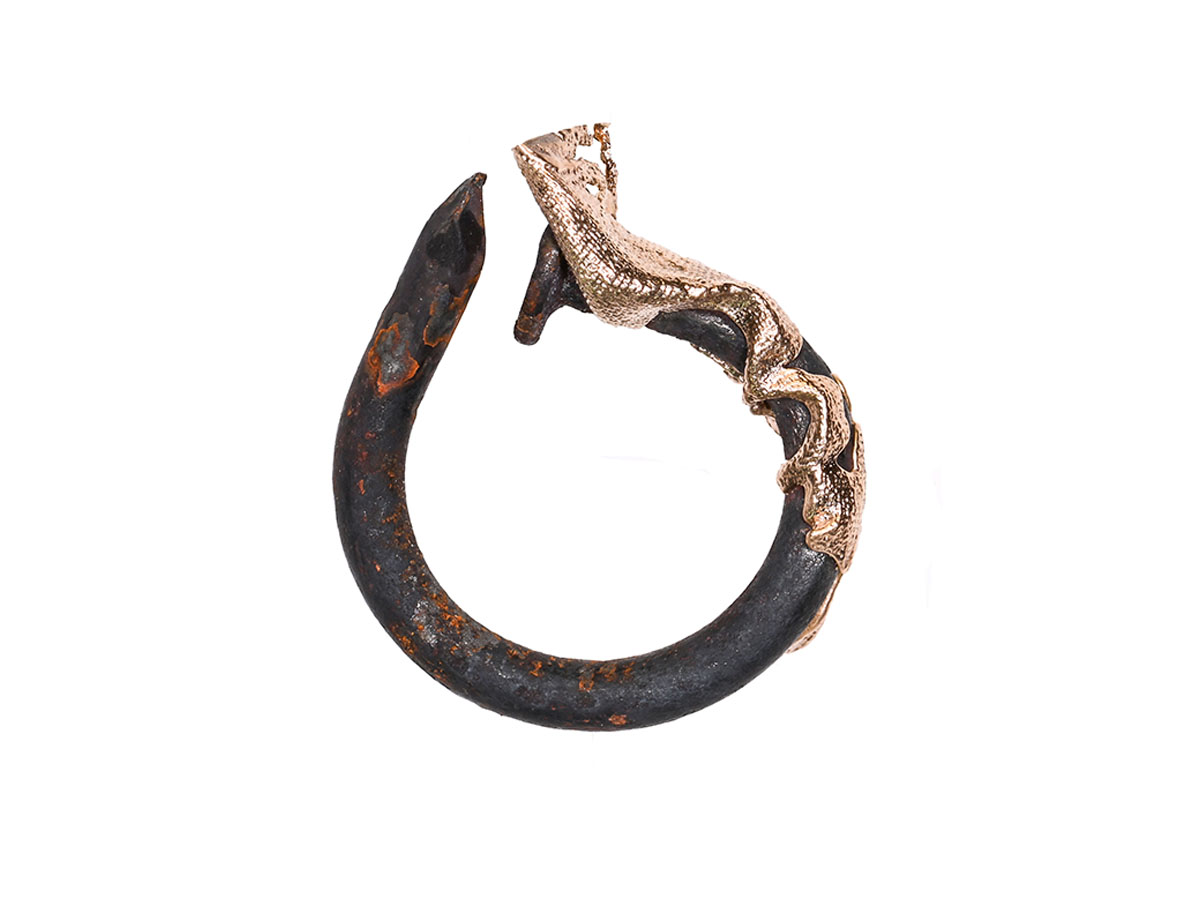
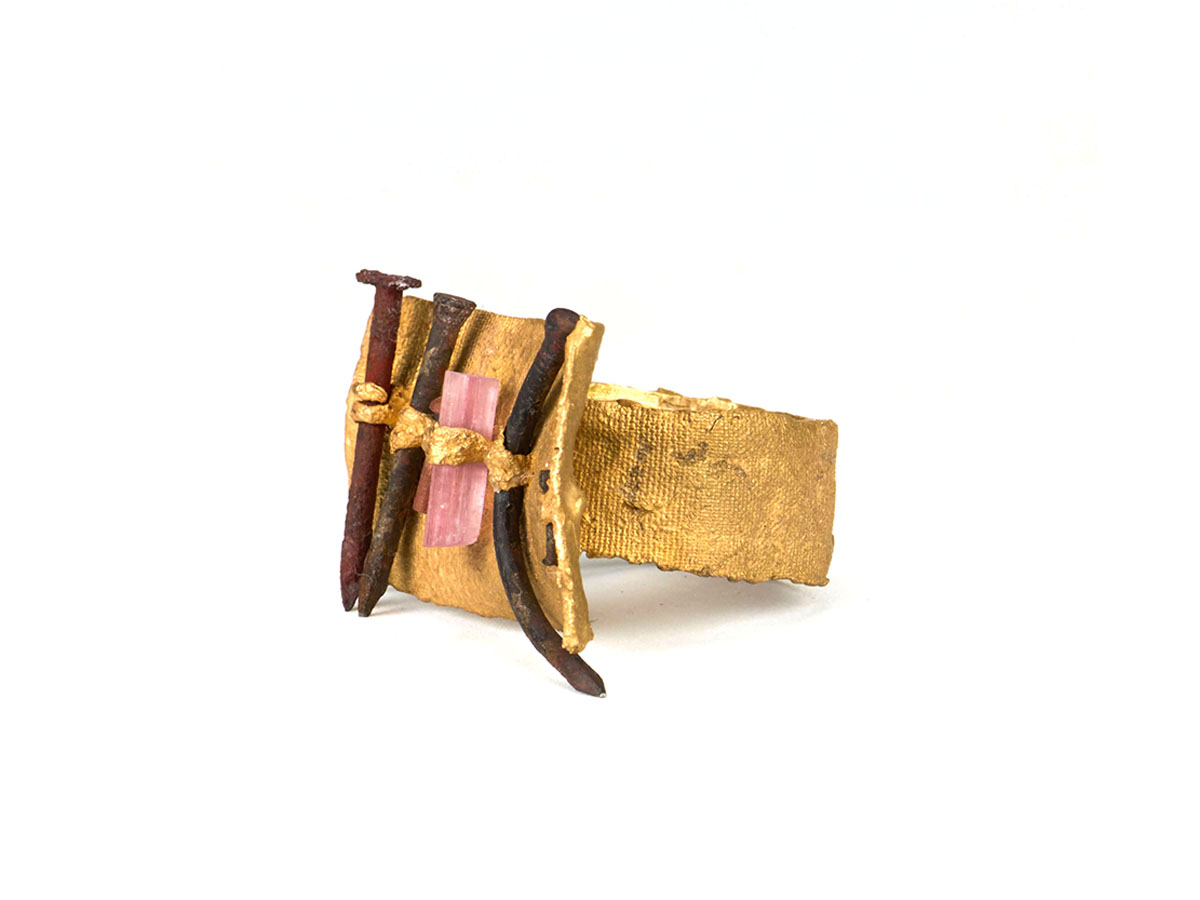
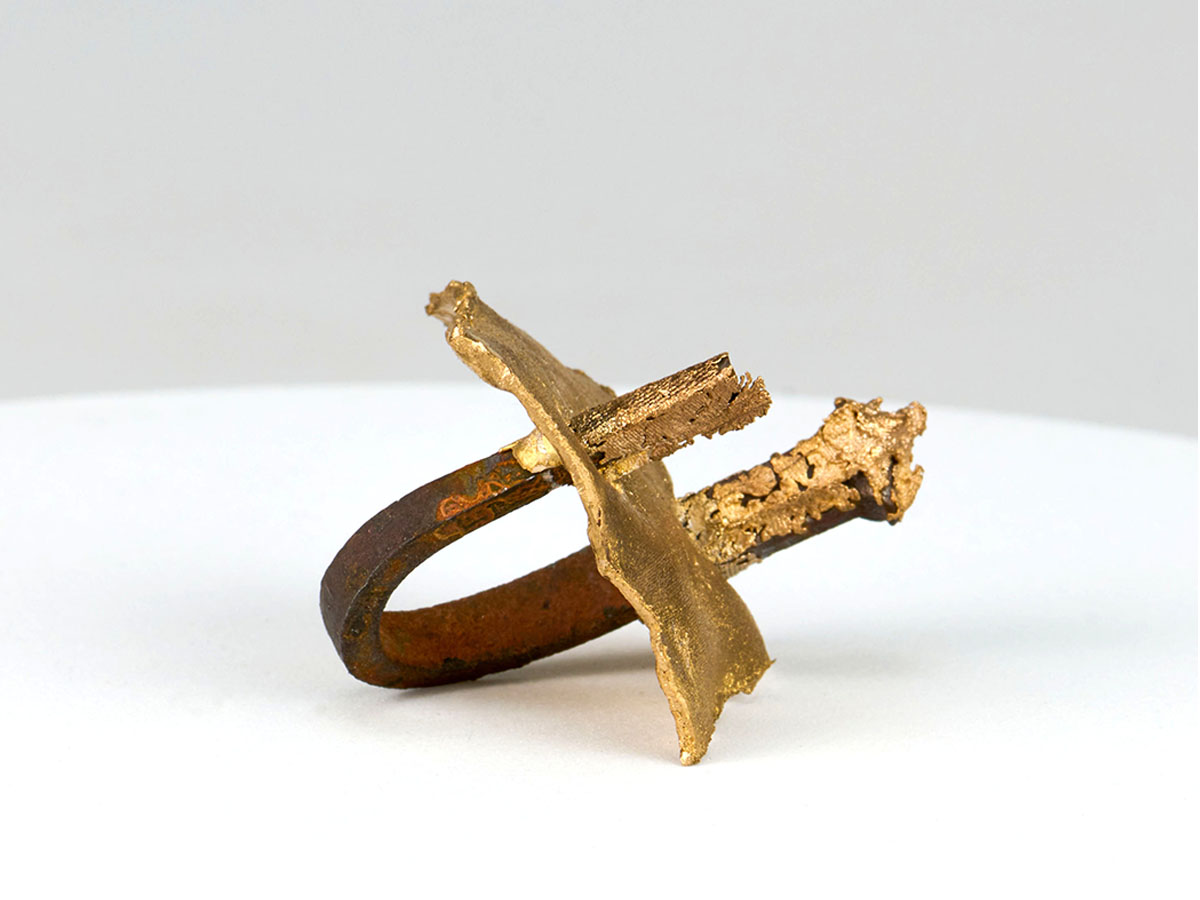
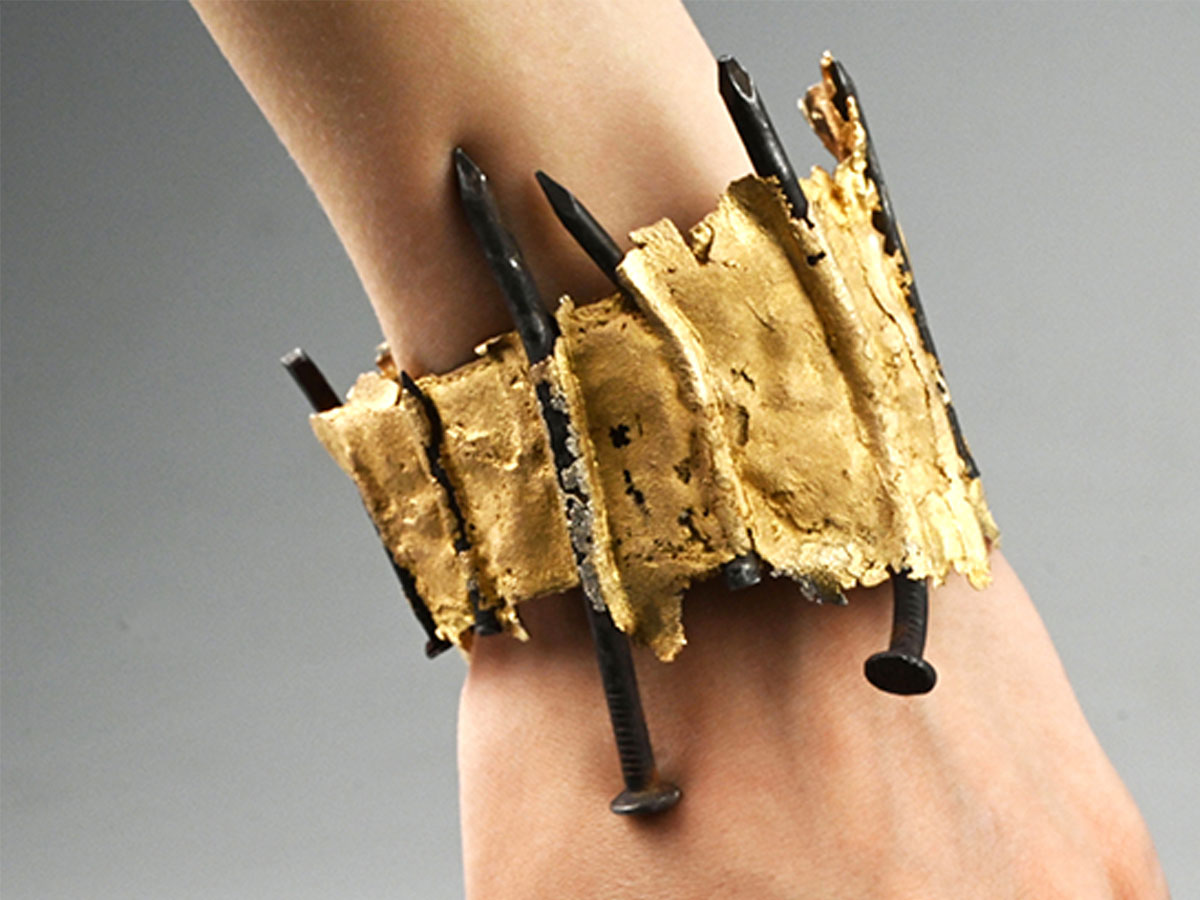
I chose Linnea Montvila for the Atelierul Award – The Iconic Ones at Cluster Contemporary Jewellery for her exceptional use of old, rusty nails in her designs. I appreciate the creative and iconic way she incorporated these materials into her jewelry pieces. She loves to tell stories, which is why the nails she incorporates into her jewelry help narrate the story of her house renovation and her creations.
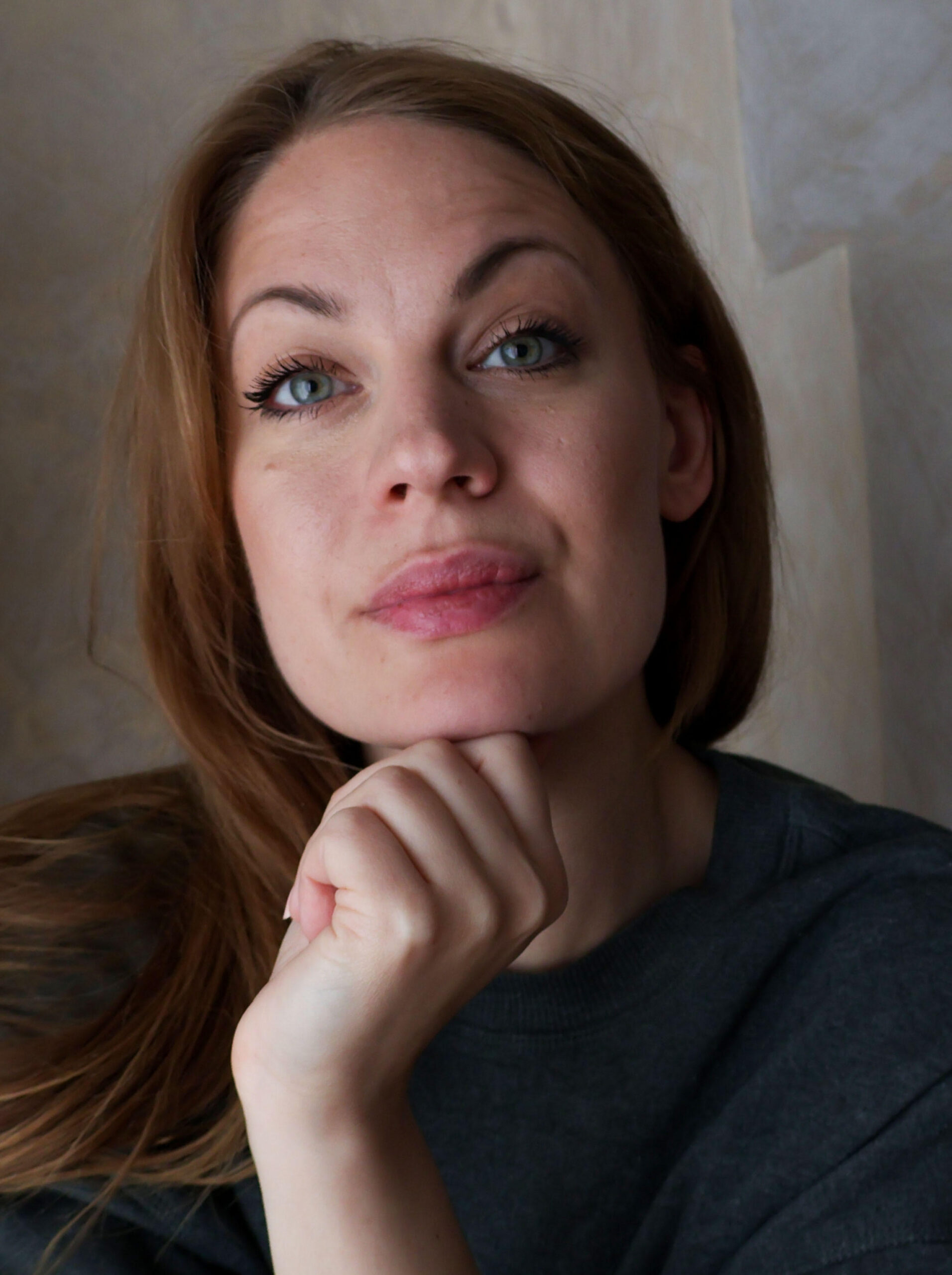
“You believe in the meaning of things and the value of personal stories. Your work is an exploration of memories and feelings, transforming found objects and textiles into one-of-a-kind pieces of art. Each creation reflects your values and passion for storytelling”. How did you get to the philosophy for your creative process?
I’ve always been drawn to things that speak to me. As a child, I collected stones, not the polished, pricey ones you’d buy in a shop, but the common grey you find on the ground. As I’ve grown older so has my taste in objects, today I’m mainly attracted to ‘rusty rubbish’. A huge driver for my philosophy is the era we live in. ‘Things’ seem to have lost their value. Growing up in the 90s, objects felt more regulated, they were either a necessity or a luxury. Today, we’re bombarded with ‘stuff’, everything is up for grabs, mass-produced for a cheap price.
Creating one-of-a-kind jewelry from found objects is my way of restoring value to the individual item. It is a reminder that objects have a life of their own and are often loaded with symbolism. It is also a rejection of our ‘fast-fashion’ society, where items trend and disappear within a single season.
I don’t just believe we need new ways to value the objects in our lives; we need to slow down entirely. What is the point of a mass-produced necklace bought for pennies and forgotten five minutes later? What does that actually add to our life?
Do you wear your creations? What is the starting point for a new collection?
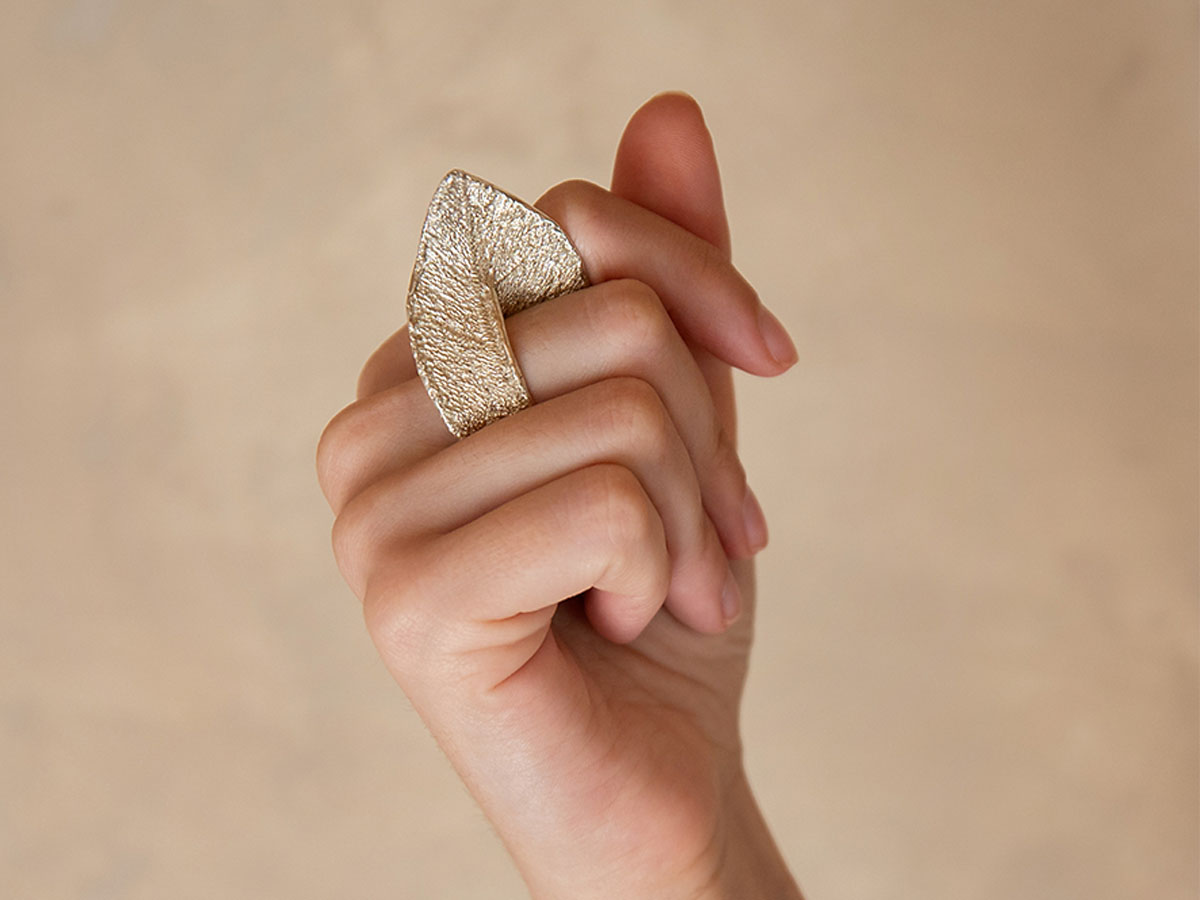
I barely wear jewelry myself, not even my lovely wedding ring. I’m always too busy at the bench or renovating. However, my husband sneakily claimed one of my nail-brooches as his, and he wears it every day.
What is the starting point for a new collection?
In the past, I started collections with sketchbooks and research. While I appreciate the calm trust in that process, and do use it still, I much prefer the sudden urge to march into the workshop with an ‘itch’, a feeling that something specific within needs to come out. I usually begin by ‘playing’ with techniques like wax-sculpting, depending on what I’m drawn to in the moment. I allow myself not to rush this part of the process. Slowly, a message begins to appear and the piece reveals itself, making it easier to analyze and focus. I often use music to trigger this feeling further. Once I start introducing more materials, I become certain of what needs to come out and exactly how it must look in metal.
As a collection develops, I look for materials that will complement the work, such as precious stones, scraps, nails, or needles. I am always collecting and love spending time with my findings. At times, a piece will be ready on the first go, other times I will make a piece and let it sit on the bench, only to pick it apart later once I know exactly how the materials need to be combined to express the message I was looking for.
How did you start your creative adventure as a jewelry designer? How does the public interact with jewelry pieces?
I have been creative for as long as I can remember. My mother was a secondary school art teacher and my father had a deep interest in the arts, so I grew up in a house surrounded by creativity. As a child, I was constantly drawing, writing poems, and taking drama classes. I was something of a quiet class clown, often laughing on the inside while maintaining a shy exterior. Because of this, my creativity has always lived in that space between a joke and a secret.
Being naturally restless, I spent my late teens and twenties travelling and moving between different countries and cities, however at twenty-nine I knew I wanted to stay in Britain and therefore settle down and focus on my creative side. By total chance, a fellow dog walker mentioned she was a jewelry maker. This led to a spontaneous Google search for courses, and I picked the first one that appeared, the British Academy of Jewelry in central London.
It was a very lucky shot. Although I started with absolutely no experience or any kind of knowledge, the tutors were fantastic and I felt like I found home from day one. I later furthered my studies at the University for the Creative Arts in Farnham.
How does the public interact with jewelry pieces?
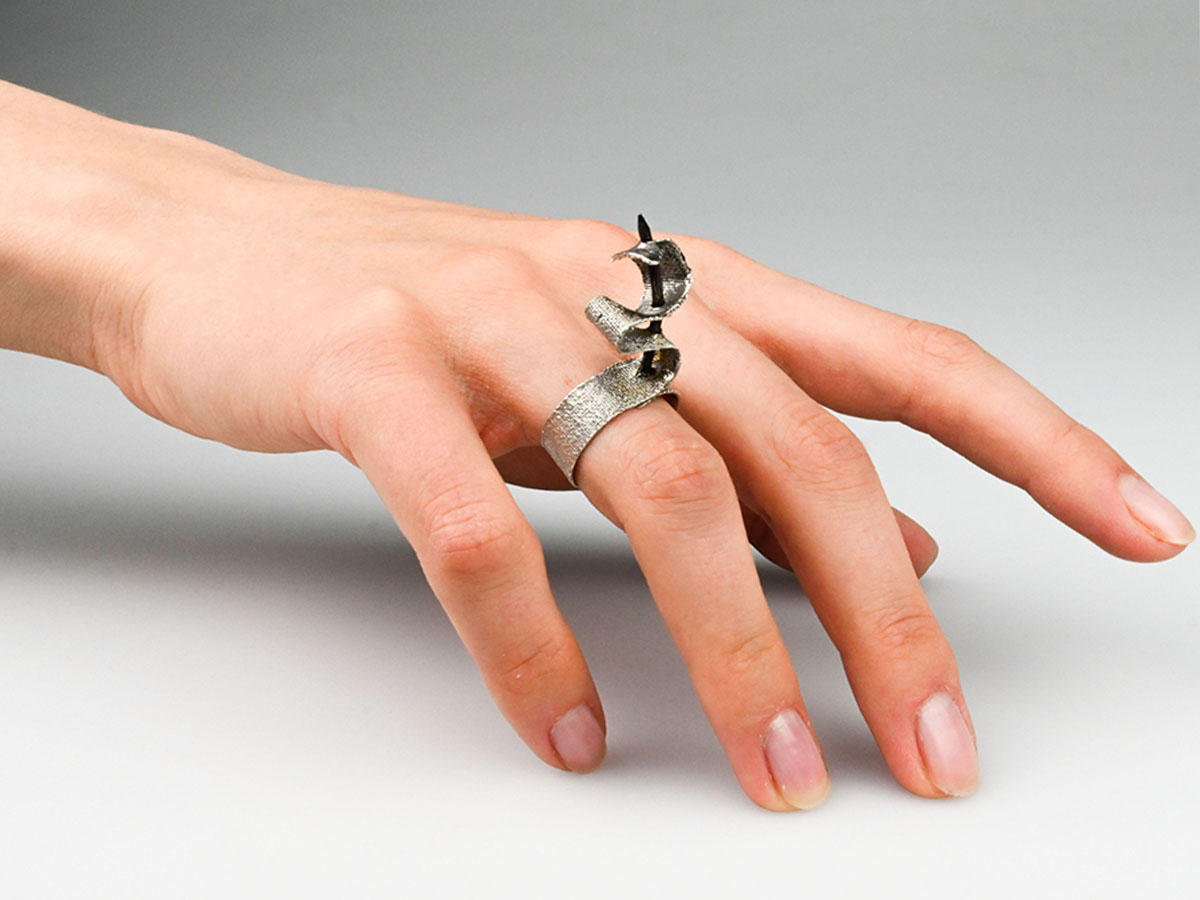
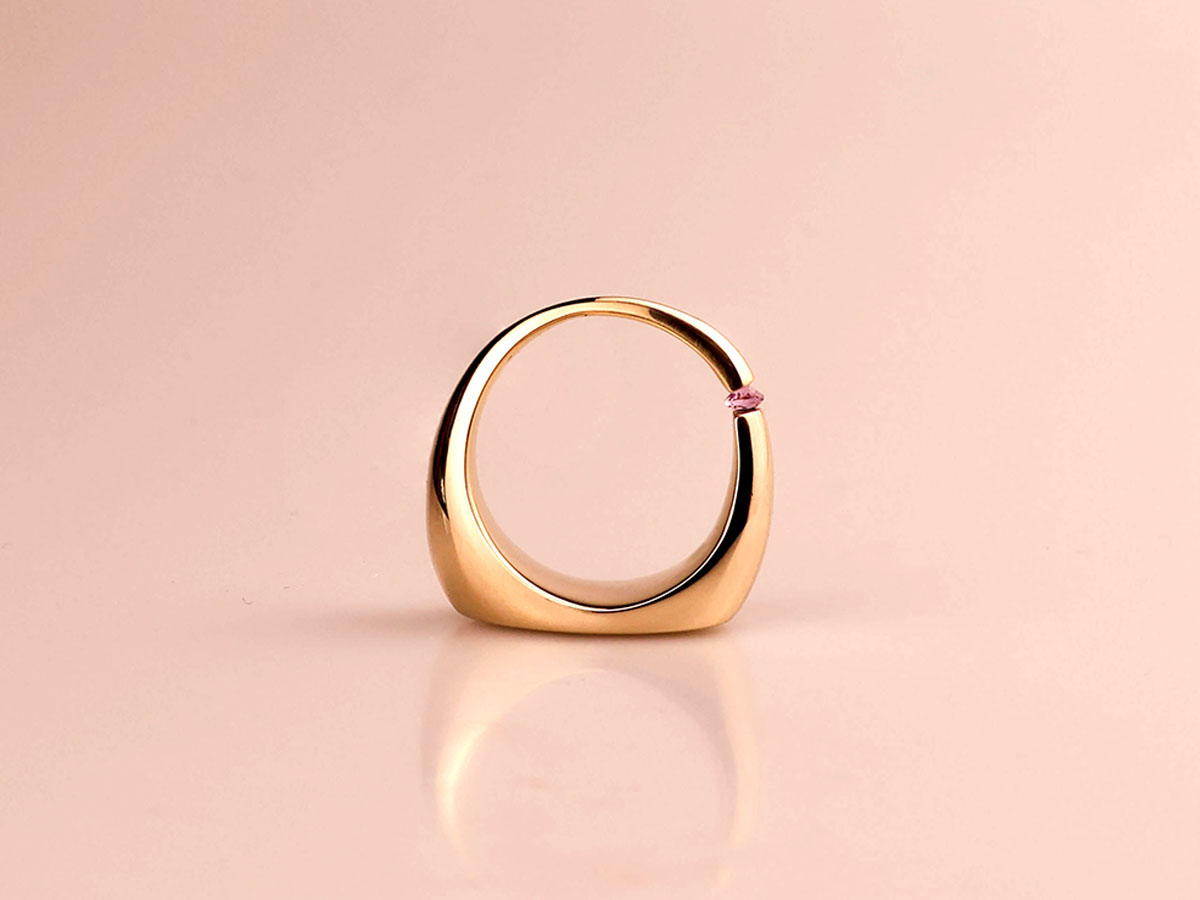
I have been very picky about where I exhibit my work, something I think many makers can relate to. I view my pieces as the start of an inner dialogue, designed to evoke a specific feeling, yet I’ve learned never to pre-judge who might connect with them or how. Since I began exhibiting, I’ve been consistently overwhelmed by the depth of conversation and feedback I receive. While I may start with one specific intention for a piece, it is always fascinating to hear someone interpret it in a completely different light. Sometimes a reaction is as quick as a laugh (which I love), and other times it leads to a long conversation. Truly, those connections are why I do this.
Recently, I awarded you the Atelierul Award – The Iconic Ones at Cluster Contemporary Jewellery, London because I was keen on your creations involving rusty nails. I read your story about using old nails during the process of renovating your house, should every designer involve their personal life in their creation?
This is my second collection where I have used iron and steel nails in my work. Most of the nails in my first collection were found during the renovation of my house and therefore that work mirrored that physical experience. In my first collection, the nails were the focus. In my latest work, the nails act as a narrative element, they are there to help build and carry the story I am telling.
I believe it is almost impossible not to have aspects of your personal life entering your work as a contemporary jewelry maker. Whether it is an appreciation for a certain texture, colour or an urge for personal expression. The life you live and the art you make eventually become one.
How did you receive the news about the award?
I was given the news by the lovely Eleonora Varotto from Cluster Contemporary Jewellery. It was a wonderful moment, she truly understands the field, so hearing the news from her made the recognition feel very special.
How do you see your jewelry in an increasingly digitized society?
I do appreciate that my work needs to exist online to some extent, but it is not my main focus. On social media, we are all bombarded by various content, in real life there is space for focus and reflection.
However, there is beauty to the extended audience you can reach online. It is a great way to get feedback and reactions from people you would never meet if you only exhibited in person. This is a huge plus. It is also a great way to discover and engage with other people’s work. I also believe that social media has been a great help in introducing contemporary jewelry to a much wider audience. But in the end, I am ‘old school.’ I most value real-life conversations where people are allowed to genuinely look at and touch my work. That’s where real focus and reflection happen.
Which do you like better, online sales or offline sales of your products?
Offline meetings allow me to take part in the connection created between a person and my work. There is something special about witnessing the reaction to your thoughts and feelings. However, online sales still give me an idea of what kind of person they might be and what they appreciate, which is a connection in its own right.
What is the most important lesson you learned in your creative career? What was the best advice you received from somebody working in the creative and cultural industries? But from a person that had a non-cultural profession?
Patience! I used to have almost none before I started making jewelry. I have taken that practice with me into the rest of my life as well. If I just take my time and do things properly, step by step, I don’t have to fiddle around later trying to clean up my ‘impatient mess.’ The result of taking your time and ending up with exactly what you had in mind is so satisfying that once you have mastered it, there is no turning back.
As for the lesson, it didn’t come from a specific person, but from the opportunity to share the stories behind my work with people at fairs and exhibitions. I always had the belief that I should hold back and give people space to create their own relationships with my pieces. However I have come to realize that I was wrong. People love hearing stories behind the work and their interest grows exponentially when they hear the story directly from the maker.
Do you have designers that you follow or admire?
Bernhard Schobinger is one of my absolute favourite artists. I am fascinated by his ability to achieve the maximum impact from his materials through incredibly simple design. To me, this is the greatest skill any maker can master. His work inspires me to truly ‘spend time with the forms of the materials’ throughout my own making process.
Karl Fritsch. I can honestly say that I had zero love for jewelry when I started making/studying it. I simply wanted to work with my hands and be creative again, and it just happened to be jewelry that I landed on. It was in the third year of college that I saw Karl Fritsch’s work for the first time, and I realized that jewelry could be stunning, and not just stunning, but interesting, creating a strong feeling of… anything, really. His work helped me understand that jewelry can have the same function as a play, a painting, or music, it is simply another medium for expression. I consider myself the luckiest woman alive to have a husband who proposed to me with my favourite Karl Fritsch ring.
Robin Shelton. Just like with Bernhard and Karl, discovering Robin’s work was a revelation, one of those rare moments of pure admiration at first sight. Robin has an incredible talent for synchronizing a piece of jewelry with the ‘home’ (box) it arrives in, creating an escalating experience of discovery. I have always felt an urge to create jewelry that serves its role just as well, if not better, when it isn’t being worn. Originally, I thought of using similar boxes as Robin that I had found in my shed, but as soon as I saw his work, I realized they were perfect for his setting but weren’t right for mine. My love for his work pushed me to find a different way to create the ‘overall experience’ of my own jewelry.
Sheila Westera is another maker who completely blew my mind from the very beginning. Sheila has an unapologetic way of telling stories through her work that I find deeply inspiring. Her pieces are visually intriguing, but what I love most is the fascination of the topics she handles. A piece of jewelry that looks so beautiful at first glance can have a very ‘dark’ yet important message behind it. I love that juxtaposition, when the visual beauty and the mental depth merge together. If you are ever lucky enough to hear her speak about her jewelry, you will find yourself completely fascinated by her vision.
How do you deal with plagiarism? Did it happen to you?
A close friend of mine spent years creating a unique clothing brand, only to see it cheaply copied and mass-produced for pennies. She wasn’t a global name, but she was highly respected in her field. While that hasn’t happened to me, I suppose you can ‘never say never.’ I doubt it will though, you’d have to be pretty stupid to think that making unwearable jewelry is a quick way to make money.
What do you think is the greatest challenge for a jewelry designer right now?
Whether you label yourself a contemporary jewelry designer or a jewelry artist, I believe you come from a place of needing to communicate and/or to make. Unfortunately, we live in a culture that pushes for fast mass-consumerism rather than an appreciation for skill, hard work, and craft. It can feel disheartening to spend time and energy on work that contains a piece of your soul, only to see it drowned out by cheap rip-offs sold for next to nothing, both on social media and in stores.
What advice can you give to a jewelry designer that is starting a creative business?
Marry rich?
In all seriousness, you must ask yourself why you want to do this. If it is solely to make money, I wouldn’t recommend it. If it is because of a genuine need or passion for jewelry (art), you will need three things: time, money and skill.
A design won’t just appear at the flick of a finger; creativity cannot be rushed. While some mediums are cheaper than others, the process will always cost you.
My best advice is to take one step at a time. Perfect your craft without stressing over the timeline. Have someone you trust to give genuine, honest feedback so you can truly understand the direction of your work. Be smart about where you exhibit. If you make exclusive, one-of-a-kind pieces, your local craft market might not be the right audience, it is often better to invest in an upmarket venue that aligns with your work. And, of course, the opposite applies.
Finally, be humble. It sounds cliché, but most people working within arts and crafts are all pushing back against the same mass-production culture. We are not each other’s competition, but colleagues, we have far more to gain from supporting one another than from competing.
All the images are sent from Linnea’s personal archive.
Thank you Elenora Varotto and Cluster Contemporary Jewellery for the opportunity to award your curated designers.

