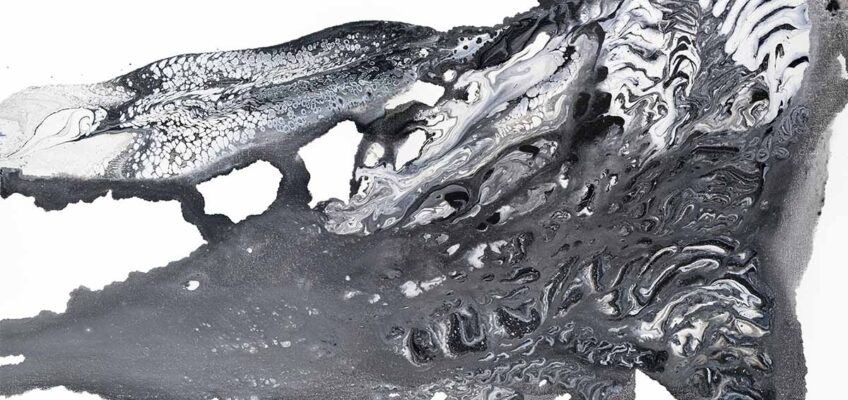
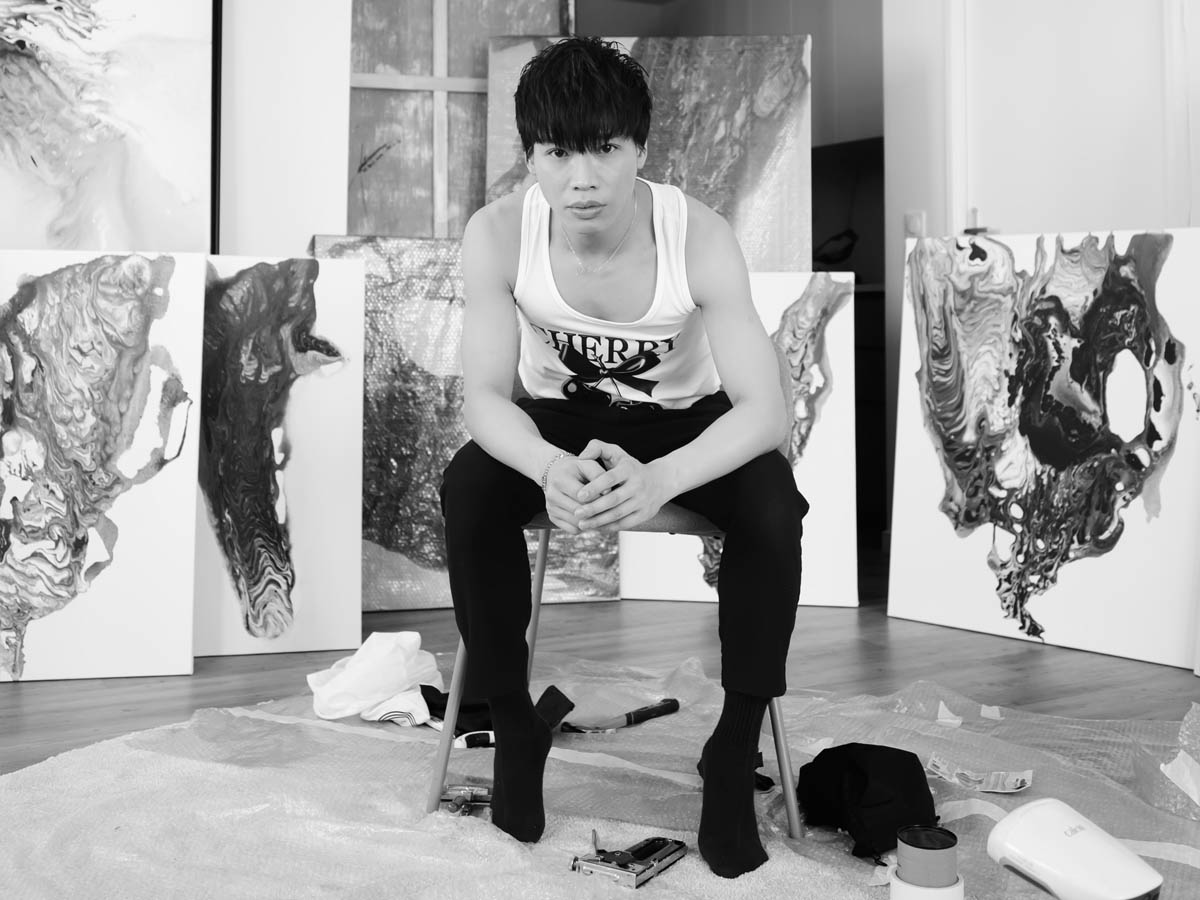
I had the chance to interview Wallace Woo about his artistic practice and his distinctive aesthetic approach. Wallace Woo is a contemporary artist based in Paris and the founder of Stalactite Aesthetics. His work pioneered the movement of Geological Abstractionism, a deep philosophical exploration of time, gravity, and the sedimentation of materials. His latest exhibition “Part I – The Silent Practitioner of Time” will open on June 5, 2026 at Espace Temple Gallery, Paris.
1. Could you tell me more about Stalactite Aesthetics and Acrylic with Ink Spirit origins? What events contributed to their developments?
Stalactite Aesthetics was not born from a place of comfort; it emerged from the crucible of vulnerability, pain, and the friction of existence. In this chaotic epoch, I believe many carry silent struggles—Stalactite Aesthetics became my strategic exit, a way to transmute raw suffering into a structural strength.
„Most fear their own shadows, yet true beauty resides in the courage to crystallize that pain. My intention has evolved from personal catharsis into a collective necessity. I operate under a singular principle: ‘I do not seek followers; I only offer a place to stand.’ I am not a spiritual leader, but through my art and theory, I provide a vessel for this transformation.”
‘Acrylic with Ink Spirit’ is the tectonic core of this aesthetic. It is not a mere technique, but a ‘materialization of the mind’ — a form of meditative practice in motion. It requires a total alignment of intent and gesture.
Paradoxically, my inspiration came from the absence of stalactites in Hong Kong. This void allowed my imagination to remain unbound by physical reality. While others perceive stalactites as mere natural spectacles, I see them as a testament to ‘Silent Persistence.’ For millions of years, these minerals never sought an audience, yet their result is an undeniable excellence. This reflects the artist’s paradox: the moment purity is discovered, it risks deterioration. By integrating Zen wisdom, I choose to address the turbulence of modern society not with violence, but with a ‘gentle radicalism’—helping humanity find stillness within the sediment.”
2. How would you define beauty through Stalactite Aesthetics’ perspective? Or better said: can Stalactite Aesthetics be defined as beautiful?
This is a very interesting question. But honestly, I don’t define beauty. I try to help people redefine it.
Coming from a high-fashion make-up background, I spent years creating a certain kind of surface — the kind that looks flawless for a moment, then washes off. And I always asked myself: „When the make-up is washed away, what stays?” Most people are afraid to answer that question, because society doesn’t allow it. They’d rather keep chasing the fleeting shadows — the next trend, the next look, the next version of themselves that fits the frame. I understand that. I used to do the same.
But Stalactite Aesthetics is not here to give you another standard answer for beauty. I grew up in a city full of labels and pre-packaged boxes, and I was suffocated by the pressure to fit into them. Wisdom, I learned, is not about finding the right box. It is about keeping an open mind — realizing that things are not just black or white, right or wrong.
If you have a pure heart, you can see beauty everywhere. That is not a slogan. That is a practice.
Let me clarify: whether something is beautiful or not should not come from my mouth. That awakening has to come from the person themselves — from their own willingness to redefine what they see.
Stalactite Aesthetics is not a definition. It is an invitation. It points to the true meaning that remains after everything else is stripped away. Whether it is black or white, heavy or light, painful or joyful — once you find that essence, it is undeniably beautiful.
3. Are there any iconic books and artists that guided you through the art world?
When it comes to the books that have guided me, many might be surprised that I first mention Napoleon Hill’s Think and Grow Rich. Please don’t misunderstand. For me, this book is not only about financial wealth. It is a study of the human mind. It taught me how to re-architect my thinking — whether in life, investment, or art.
There is a subtle synergy between this book and Zen philosophy. It taught me how to clear away toxic noise and pursue a vision with strategic clarity. I came to realize that art is not just raw emotion. It is the materialization of one’s mental state. To create a work with real pressure on the canvas, the mind must first be built with unshakable intent.
This book taught me that the starting point of any creation is the thought itself — like the first drop of mineral water that begins a stalactite. If the intention is pure and firm, the final work will carry the ‘Silent Persistence’ I always strive for. It is a guide on how to transform invisible energy into tangible reality.
As for the artists who have inspired me, I am particularly drawn to the 20th-century giants of abstraction: Kandinsky, Pollock, and Rothko. They pushed abstraction to its limits. Kandinsky explored the spiritual music of form, Pollock captured the raw energy of action, and Rothko touched the sublime through pure color. But standing on their shoulders, I asked myself: is there still space to evolve within the abstract system?
They mastered the spiritual, the kinetic, and the emotional. But I felt there was another dimension yet to be fully explored — the geological and temporal dimension. That is where Stalactite Aesthetics begins.
If Pollock represents the instant burst of energy, my work represents the eternal accumulation of time. I am not rejecting their foundation. I am moving toward a new frontier — one that integrates Zen wisdom with the physical pressure of sediment. I don’t just want to paint a feeling. I want to grow a reality on the canvas, layer by layer — the way time grows a stalactite.
4. In your presentation, you define your artworks as “not merely paintings but visual records of time layered upon time, inviting viewers into a space of profound stillness and reflection”, how did you got to this definitions?
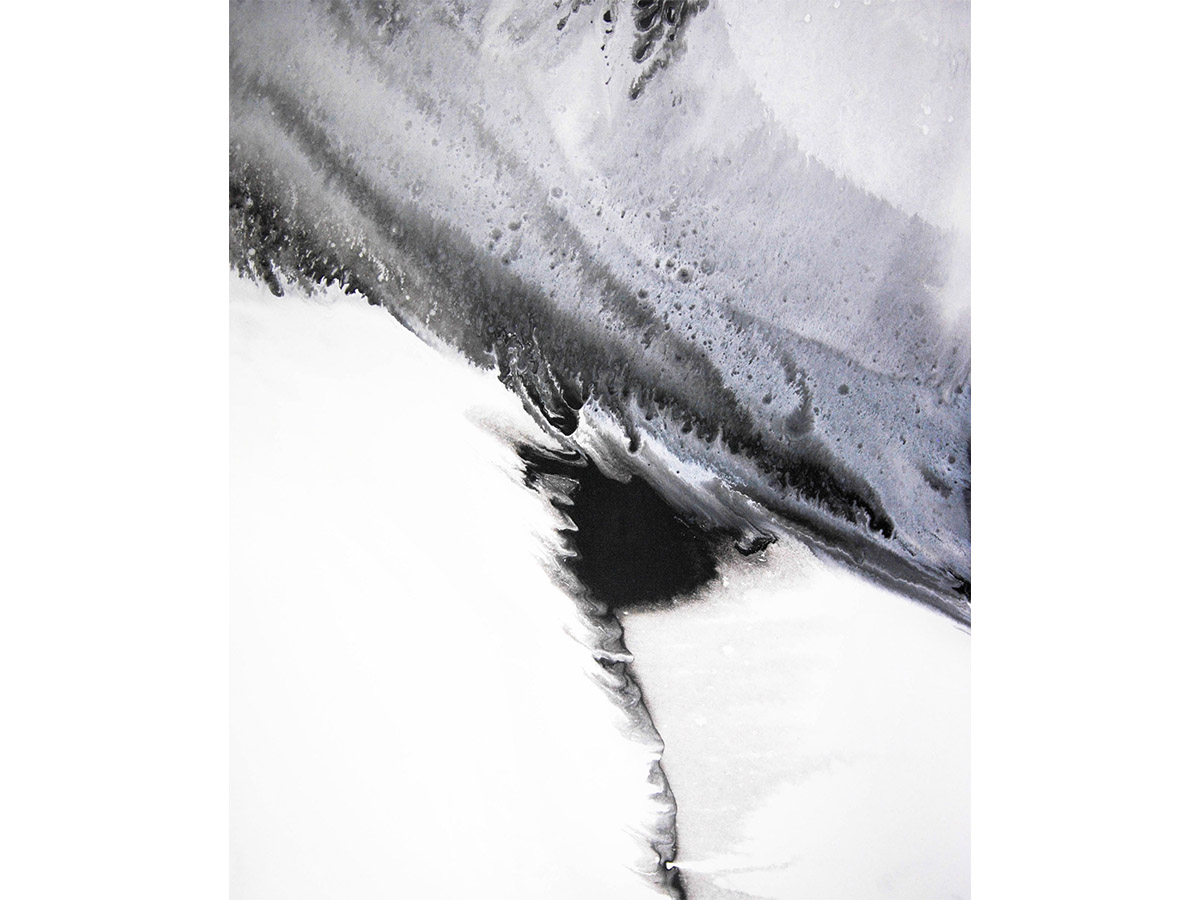
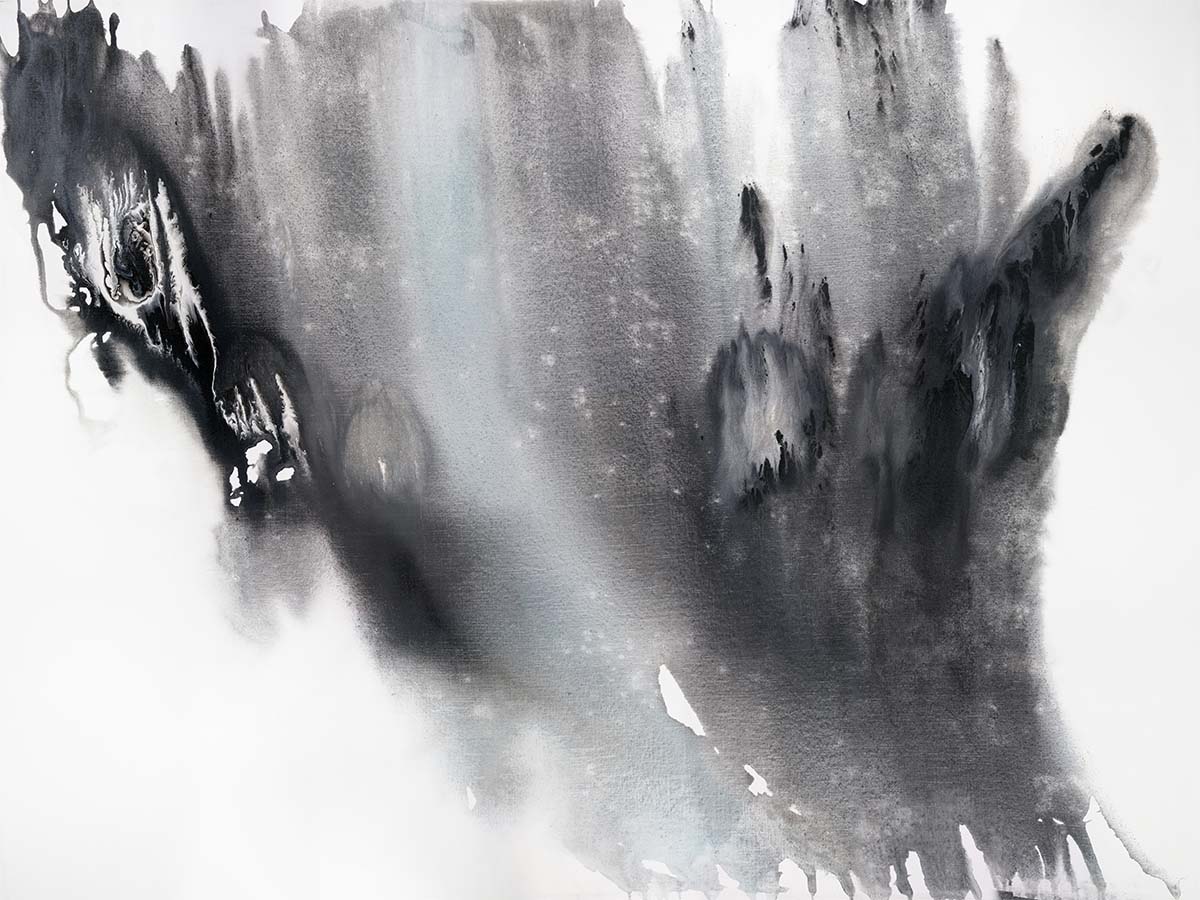
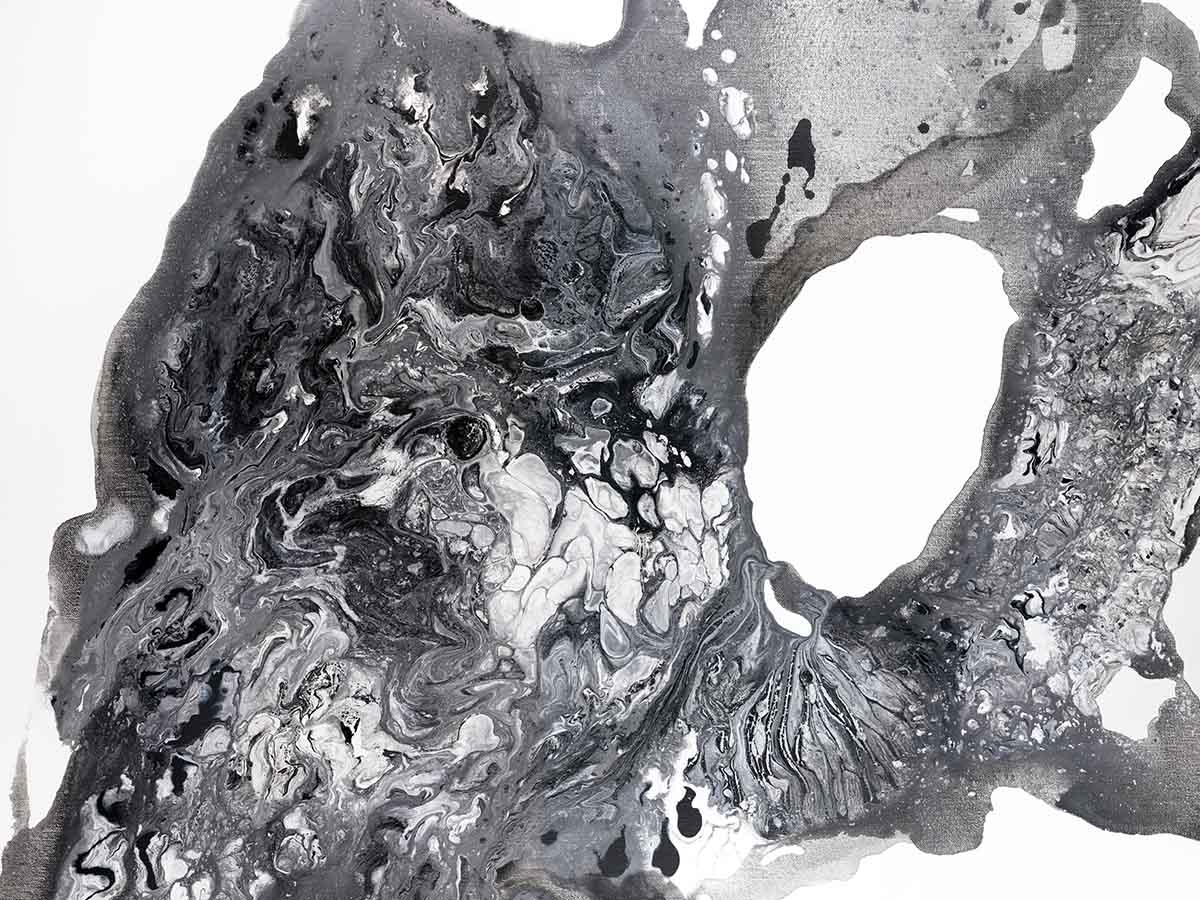
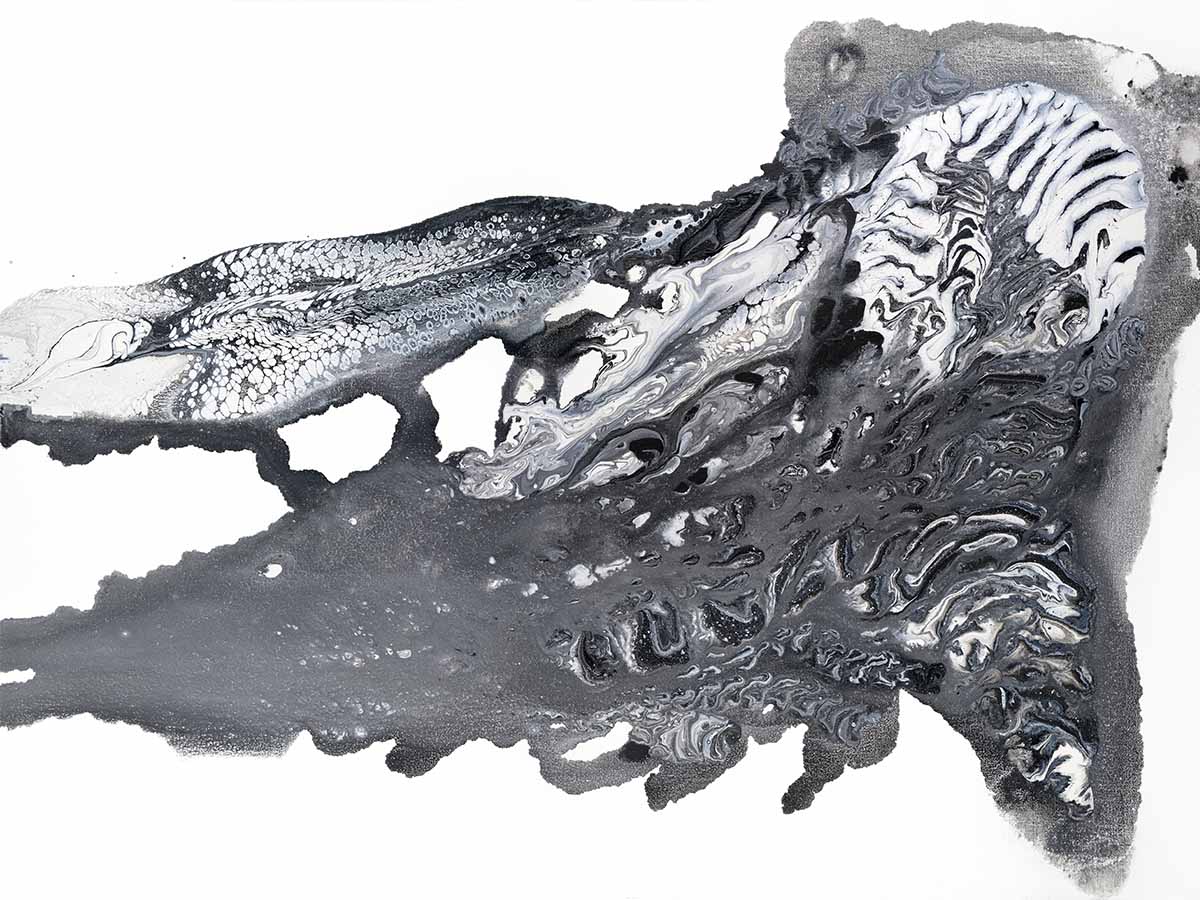
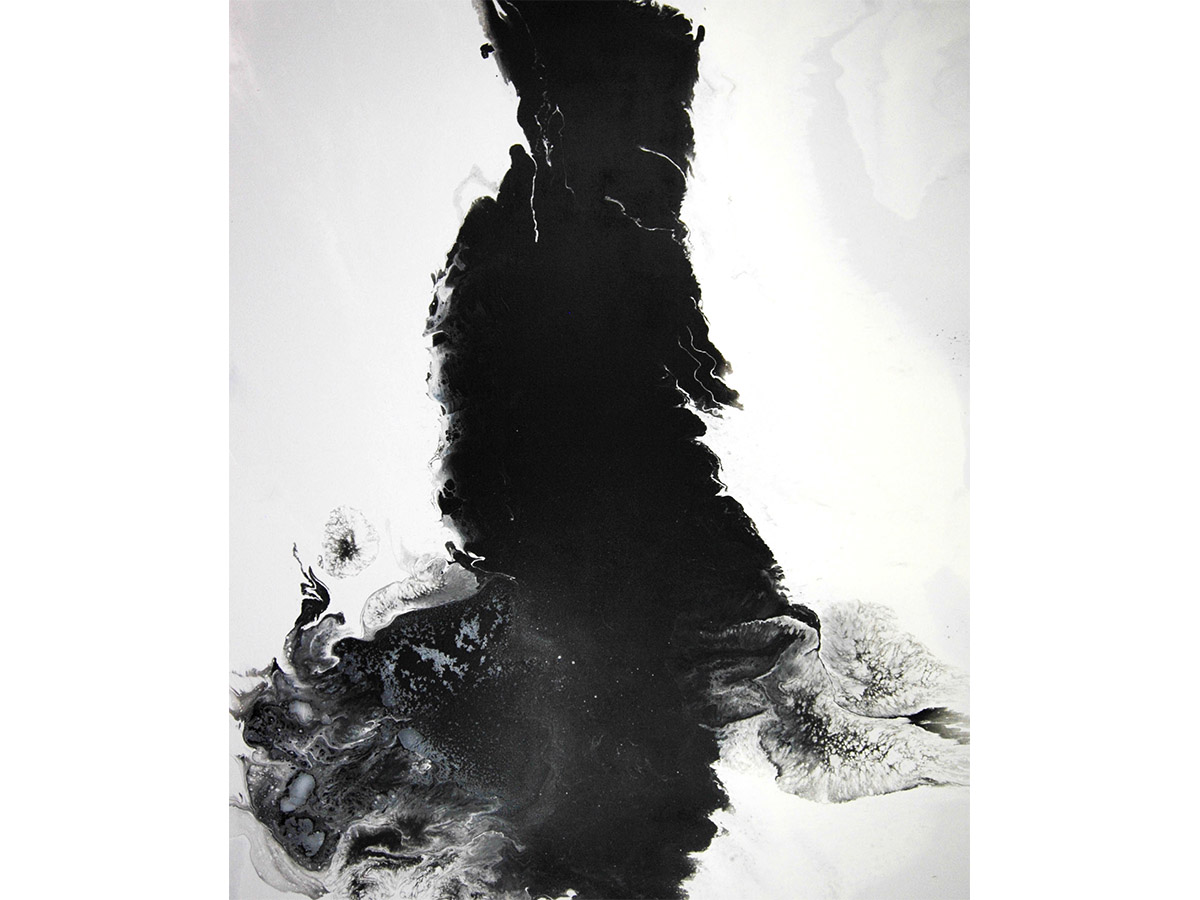
I constantly re-examine my position. Actually, I should not define myself as a painter — not in the traditional sense. I don‘t use my hands to draw images on the canvas. I pour, I tilt, I wait. I collaborate with gravity, with time, with the material itself. That is why I call this performance art, or improvisational art. But I hope people won’t be disappointed — my performance is very slow. It won’t shock you. It takes time. Sometimes I feel a little foolish. I know I’m doing something that goes against the rhythm of this era. But here’s the thing: no matter how wild the party gets, in the end, everyone goes home.
In each creation, I go through a four-element cycle: Wind, Fire, Water, Earth.
Wind is the beginning — breath, intention, setting the point.
Fire is the first drop, the first strike, the ignition point.
Water is the moment of development and expansion — the flow, the accident, the unfolding.
Earth is the settling — waiting for it to dry, letting it become what it needs to become.
A completed painting must pass through all four. I see this as a meditation process — just like the natural cycles of our planet: glacial periods and interglacial periods, volcanic eruptions and sedimentary deposits. Together, they form the final landscape. That is not just painting. That is letting time become visible.
5. What is your flagship artwork? Why do you think it is that one?
If one day an art museum collects my work — maybe one day from Romania, I look forward to that — I’ll come back and tell you which one is my flagship piece. But at this stage, I can’t give you that answer.
What I can do is name a work that I truly love. For example, my very first collection, Zentimeter.
I love it because the starting point was very pure. It always reminds me of the question: After letting go, what remains?
I also intentionally turned the “C” into a “Z” — to let people know that Zen is always around us, just a tiny mile away. When you need it, it’s already there.
6. Art is work; how can artists make the statement even bigger?
Let me break this into two parts: the creation part, and the follow‑up part. For me, creating art is not work. I don’t take it as a job because I enjoy the process. I don’t feel tired. I feel excited every time — because I found my flow.
The problem is not the creation. The problem is what comes after: the marketing, the selling, the networking. I don’t enjoy that part. It reminds me of the time I worked in the fashion industry — the same pressure, the same performance. I left fashion to escape that, but in the end, I have to come back to it. Ridiculous? Maybe. But I have to deal with it.
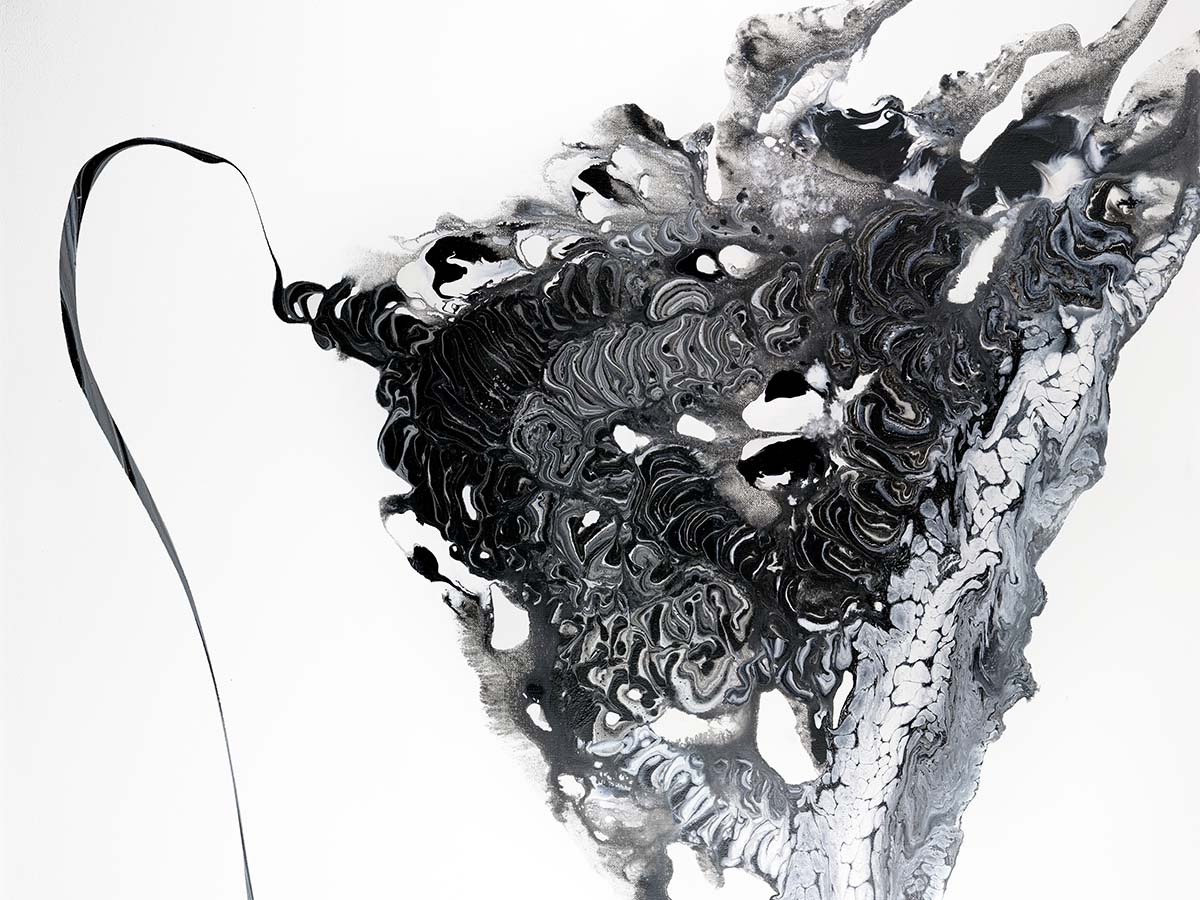
So I don‘t know how to make the „statement bigger.” I only know how to keep making the work. The statement is the work itself. But let’s be honest — right now, a meaningless video probably has more impact than anything I‘ve ever made. But I truly believe that the universe has many ways of teaching you — through struggle, through resistance, through things you don’t enjoy. And somehow, in the middle of all that, we grow stronger. We grow wiser.
7. What valuable lessons can be drawn as an artists in an increasingly industrialized marketplace?
In this 21st century, we are facing a paradox. We see reality portraits with perfect technical precision, and AI can now generate any visual phantasm we can imagine. But we must ask ourselves: Is this helping us evolve, or are we just running in circles?
Nowadays, it seems people only want to be entertained by optical illusions. They seek the instant pleasure of being deceived by a clever surface. It‘s ironic — while technology advances, our aesthetic appetite remains stuck in craving these shallow tricks. We applaud technical perfection, yet we forget to ask if there is any soul beneath the surface.
We celebrate masters like Monet, Van Gogh, and Picasso because they did a brilliant job defining their own centuries. But art history cannot stop there. If we only chase visual perfection or digital speed, we are staying at the same point.
In an increasingly industrialized market, the most valuable lesson we can learn is this: Art is not about “production”; it is about “presence.”
The reason I initiated Stalactite Aesthetics is that I believe we need a breakthrough that AI and machines cannot replicate — the weight of time and the soul’s friction. AI can create a picture, but it cannot live through the process. It doesn‘t feel the pain, the waiting, or the four-element cycle of Wind, Fire, Water, and Earth.
As artists, our lesson is to stop competing with the speed of the machine and start returning to the “Silent Persistence” of nature. We must move from the surface to the sediment. The market may be industrialized, but the human spirit is not. Our breakthrough lies in creating something that doesn’t just look beautiful, but something that exists with the undeniable authority of time. Unfortunately, no one listens to this anymore. The world moves too fast. So I need to stand up and speak loudly. I published my theoretical book The Dimension of Sedimentation (ISBN 9789887189022) — to speak with proof, with asset. I hope humanity will awaken.
8. Revista Atelierul’s audience also includes young designers, architects, and artists. What advice would you give to someone aspiring to become an artist?
Realistically, I would tell you to first settle your financial situation before considering entering the art world. Or try to do both at the same time. I say this from experience — not from theory.
9. How do you see a creative world where products and artworks are more sustainable and ethical?
A sustainable artwork is one that carries the weight of time. It doesn’t pretend. It doesn’t chase trends. It simply exists — layer-by-layer, drop-by-drop — and waits to be found. The ethics I’ve come to recognize is this: no manipulation of the answer, just purity. Don’t make something just because the market asks for it.
If you want to create something sustainable, don‘t ask what sells. Ask what stays.
10. Should artworks be affordable? Why?
Art is not supposed to be related to money. It’s the world that gives it a price — based on social conditions, not on its essence.
I would be happy to donate my work to an art museum. But that doesn’t mean they have to accept it. If they don’t see any value — whether the price is high, low or free — it all comes down to basic human behavior.
In fact, you can pick up a beautiful stone from the street, and that can be art — for free. It depends on how you see it. And it also depends on whether you care about how others see it. Either way, it all comes from within yourself.

