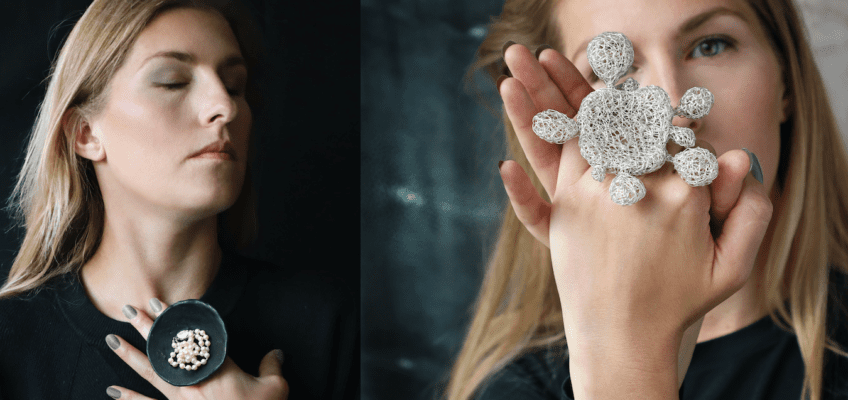
Sheila Westera was honored with the Atelierul Award – The Iconic Ones, during the exhibition „I Don’t Shine, I Have Something to Say” at Venice Design Week 2025. Sheila is crafting unique, one-of-a-kind jewelry pieces that highlights the natural beauty of stones, in an innovative and unexpected way.
Her creations have increasingly become a reflection of her own experiences. She became intrigued by our obsession with shiny objects—what does gold genuinely symbolize? Sheila challenged the idea of adornment itself and uncovered the beauty that can be found within it. And that’s why I chose her as a laureate of the Atelierul Award – The iconic ones.
1. In the last 24 years you lived and worked in Amsterdam, London, Rome and finally in the Swiss Alps, where you are located for the moment. How did your creative processes change with each city, in each country?
Growing up in the Netherlands, I was exposed to the high-end and fine jewellery field through family. I started by serving coffee on Saturdays as a teenager, did a general jewellery education, and I wanted to learn about stones, even though I wasn’t sure which direction my life would take, I was somewhat fascinated by the craft of gold smithing, admiring the work of master goldsmiths, and overall I wanted to learn as much as possible.
Later, when my boyfriend’s father, a sculptor and contemporary jewellery maker who exhibited at Galerie RA and Galerie Biro in Germany amongst others, introduced me to contemporary jewellery, I became curious about this more thought-provoking field. During my studies in art history and architecture, I was also researching and visiting contemporary jewellery galleries, and working in the fine high-end jewellery field in Amsterdam. Jewellery had me under its spell. The Netherlands has Calvinistic roots that you can still clearly sense, and gold and shiny objects weren’t the first thing that people would spend their money on when I grew up. I found the Dutch exploration of non-precious materials in contemporary jewellery that started in the 60s particularly interesting. The field of antique or ancient jewellery had my interest too—simply hungry for knowledge. Visiting antique shops and auctions became a passion, and as a critical thinker, I was also asking myself why people have the need to adorn themselves at all.
At an exhibition in Amsterdam, probably around 1993, I learned more about the Scythians, a nomadic people who were highly skilled craftsmen in gold. How these first craftspeople in ancient times worked in the most basic way, creating works of art with simple materials and tools, interested me. Later when attending gold smithing courses in Amsterdam and in London I wanted to explore more of this field that I still wasn’t sure about, and probably it had to do with the idea of dedicating your life to a craft, which felt so tiresome, having seen so many goldsmiths in my lifetime. When moving to London, where I was living for 15 years, I was much more exposed to the elegance and jewellery of a cosmopolitan city. People wore colourful stones and large interesting pieces, making them real personalities—fascinating to observe.
When spending time holidaying in nature and often being confronted by debris, it made me upset. Fernand, my friend and Alpine guide, went into the mountains one day to once again be appalled by what people leave behind. That same week, I found debris washed up on the shores of Lac Léman, maybe thrown into this pristine Alpine lake years before, which made me take some kind of action, resulting in creating a necklace from this rubbish, making it a statement about how people are treating nature. This is when I discovered I might possibly be an artist one day, as everything started to make sense.
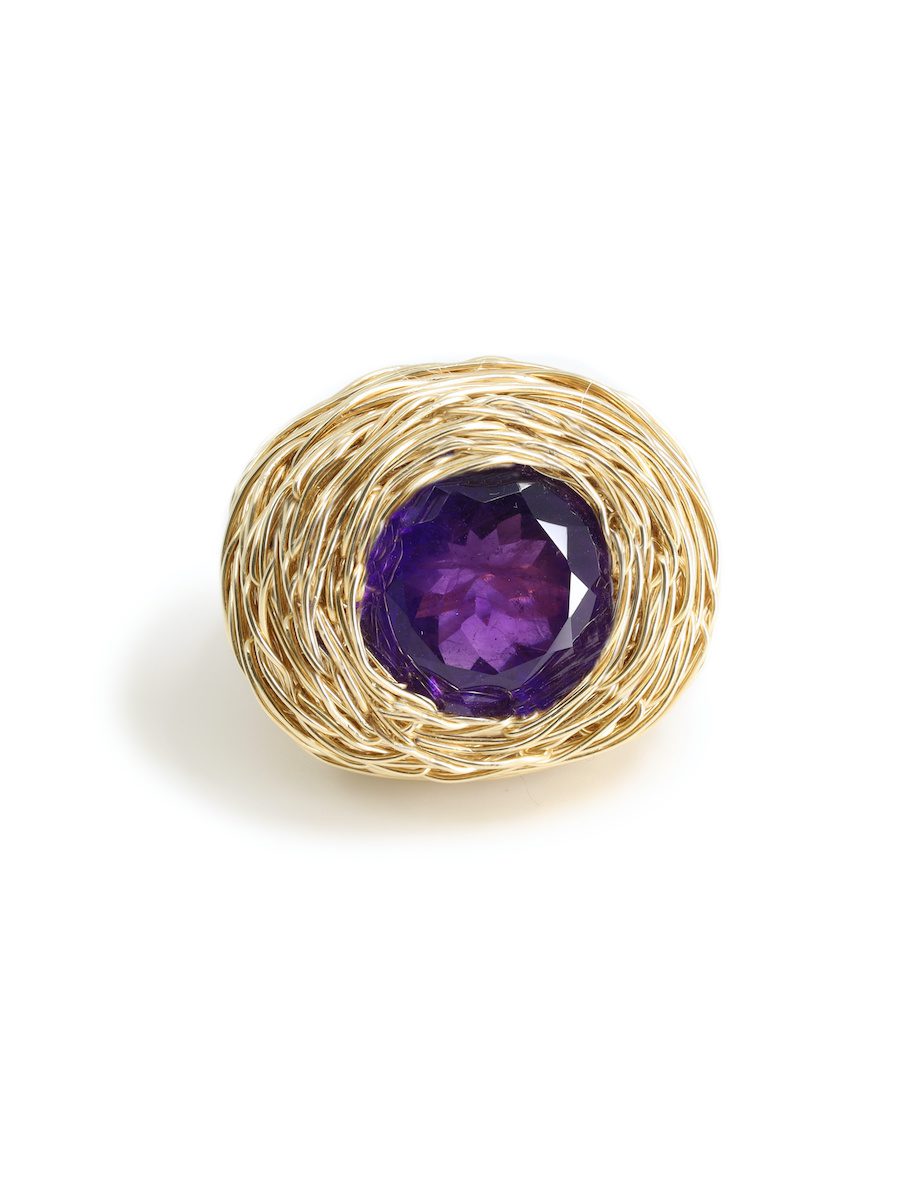
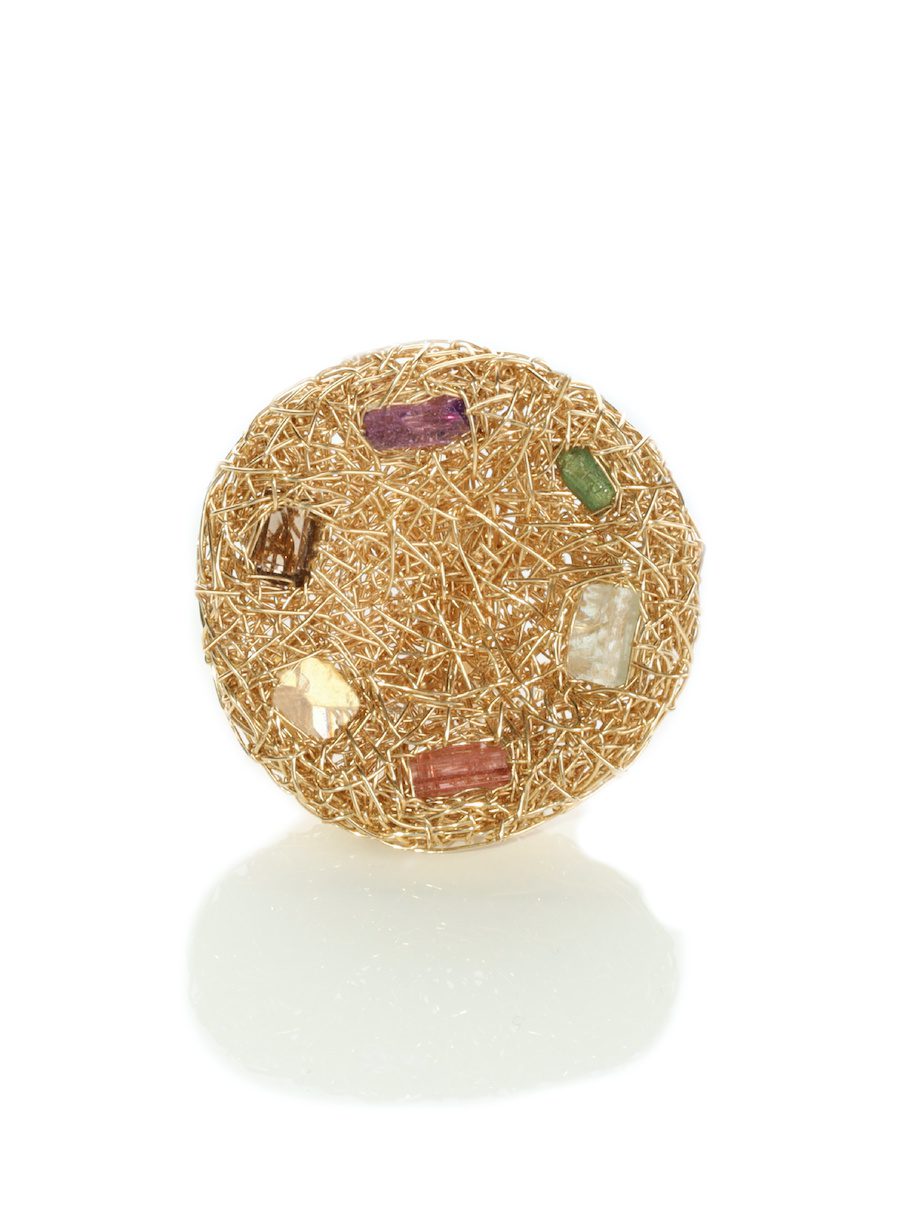
For years I was collecting gemstones and stones, and one day I created a ring for myself whilst living in London, when I was playing with wire.
This large stone statement ring enticed my friends, and more people wanted to own such a stone ring, and before I realised it, I became a maker, and my path was born, whilst realising that if I ever would become a jewellery maker, it had to be different from anything known so far. After this I spent years developing my style and with it a strong technique.
When moving to Rome, where we were living for almost two years, I started to take myself a lot more seriously and the more provocative jewellery and larger pieces were created to test how far my technique and creativity would take me. They were perfect for photoshoots, projects I started doing more with other creatives. Critical yet seeking beauty. A loner who needs a community. When moving to the Swiss Alps, I took my creativity up another notch. But first I realised that being surrounded by only nature, next to living in a village for the very first time in my life, yet another thinking phase had started. Then Covid arrived. Well, let’s say I needed the time to know where I am today.
2. Recently, you showed to the public your design creations. Do you think all the years of learning and developing your artistic voice had a strong effect on your style? What made you show your creations only in 2024?
Part of the answer can be found in the above. I’ve always been strongly interested in a variety of subjects, and also in beautiful things like stones. But mostly I have been interested in what’s happening around the world. I question, for example, what if humanity as a whole would truly learn to better ourselves for the greater good, like taking care of our planet, stopping wars, machismo behaviour, simply becoming the best version of ourselves. We humans can’t seem to learn much from history. So I always find myself in-between questioning and admiring beauty, and I found out that the latter is much needed to keep myself sane, to be honest.
After my forever soul-searching, I first started exhibiting my work at a group exhibition in Milan, and when Covid hit, with the benefit of living in the mountains, and its freedom, I had the time to develop my website and social media once more, after clients were asking to see more. At the same time I kept developing my other work, just to feed my deepest soul, as I have always something to say. Even my friends find me a nuisance sometimes for being critical, so creating wearable artworks in which I can express myself truly became my rescue.
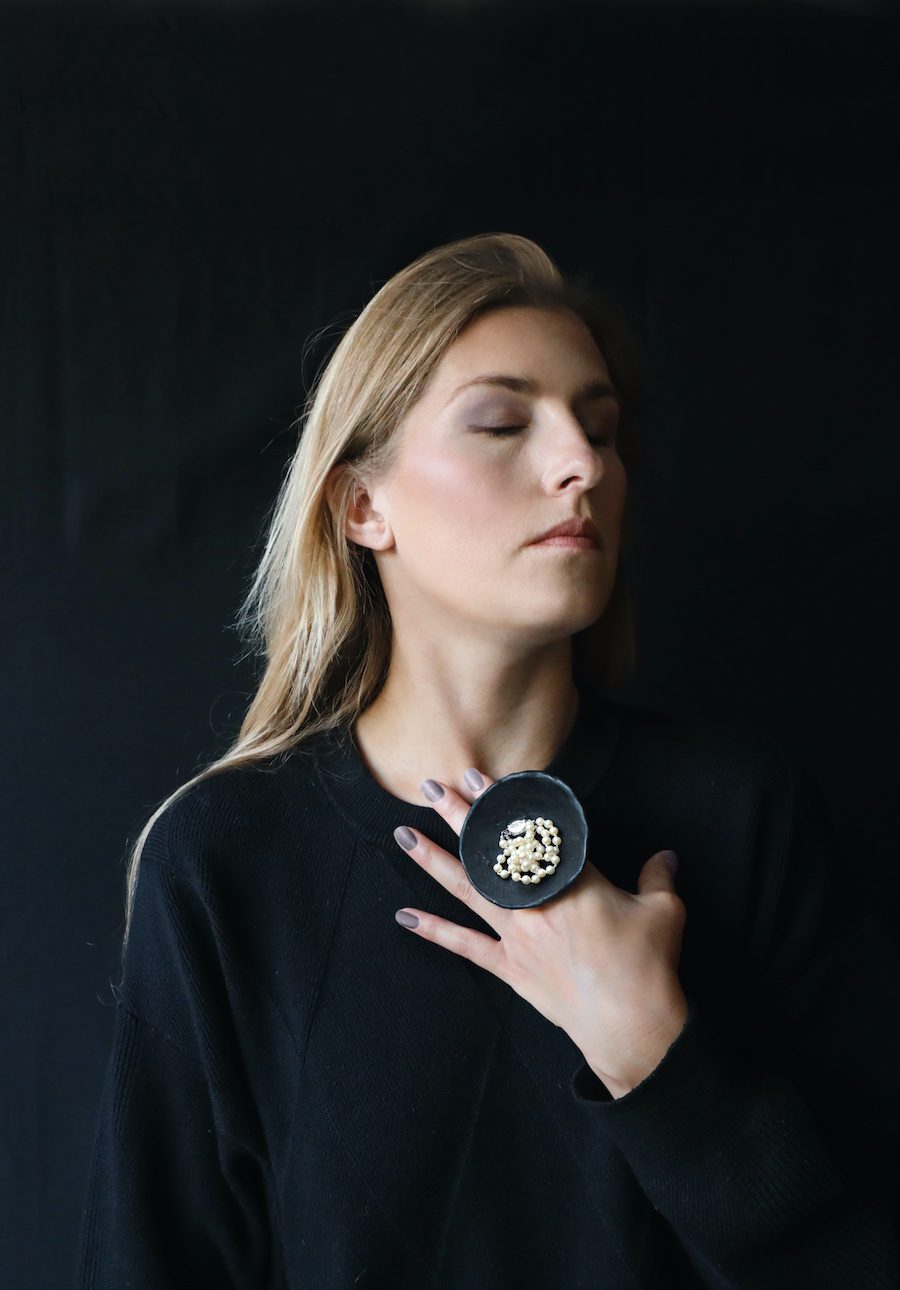
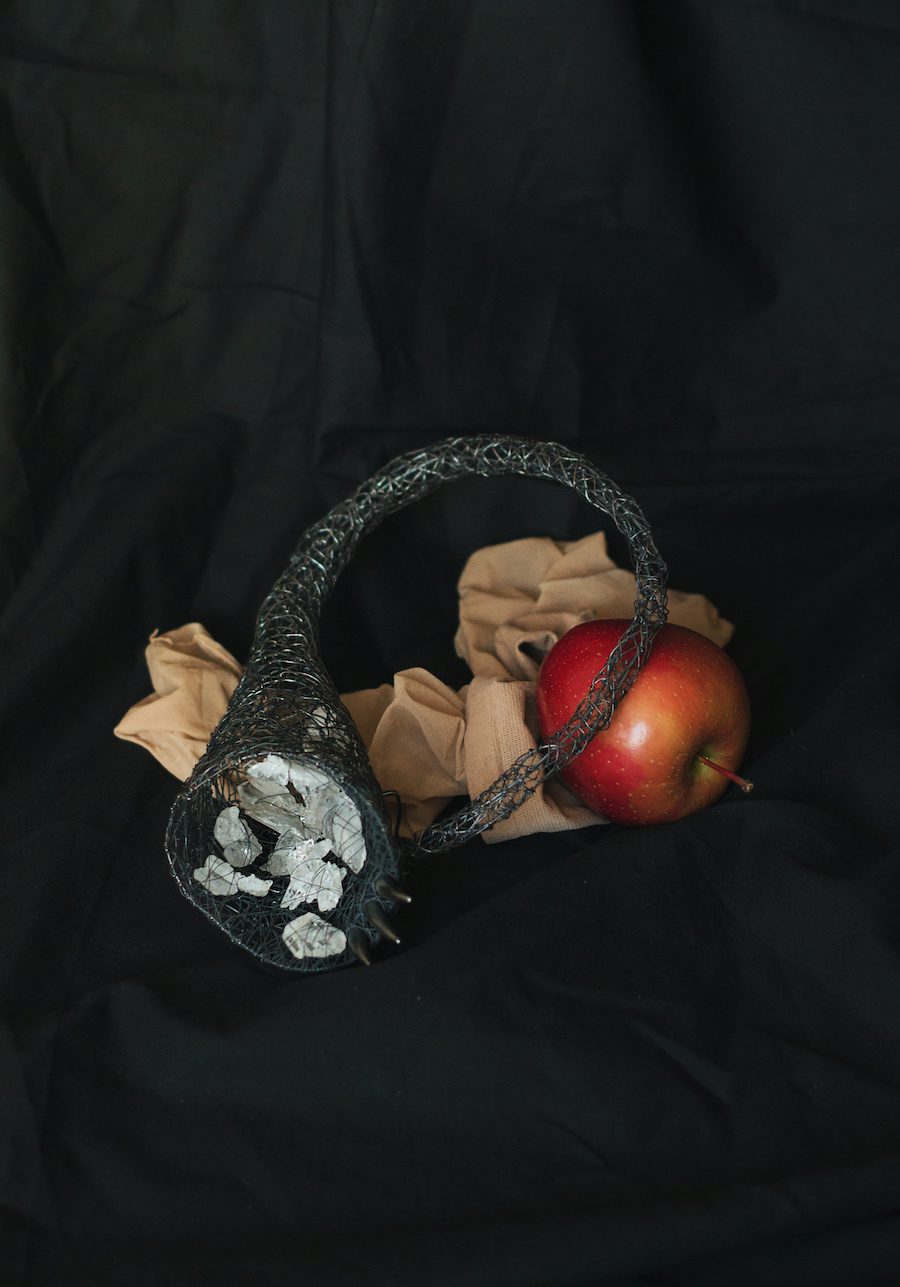
I think that some of my works that come with names like: ‘Gold digger’, ‘Poser’, ‘Macho Man’, ‘Cornucopia’, ‘Myth’, ‘Endangered’, ‘Pile of Rubbish’, ‘All the Fish in the Sea’, ‘Crowd Pleaser’, ‘Mega Show’, ‘The Helping Hand’ and so many more, I like to entice a conversation, but today only with people who are interested in what I have to say. I started to exhibit my work at SIERAAD in the Netherlands, and at Cluster London, Contemporary Jewellery in 2024 and in 2025 after more emails followed, came Venice Design Week, Florence Biennale, Cluster London, and last but not least a solo weekend exhibition in Amsterdam at the end of November.
After experiencing Venice, where I won three awards, and finding myself surrounded by more art and artists, or like-minded souls, I now know that this is my true path, as I am a creator.
3. You believe that „jewellery should spark thought or celebrate your authentic self, rather than simply complement an outfit”. How did you get to this philosophy? Do you wear your creations? How does the public interact with your jewellery pieces?
I found that in the Netherlands many people would wear a similar style, and I was more curious about finding different styles and more individuality. I simply would chose the colour that I liked instead of taking the colour that was trendy. I can honestly say I was never a follower. I loved finding things from my mother’s cupboard or by visiting thrift stores or unique shops. The first stone ring that I created was because I couldn’t find anything that looked interesting enough to me. I started practising my own techniques more whilst living in London, and I wanted it to look how I envisioned it, sculpted by my hands.
To wear an accessory to fit an outfit comes with a completely different approach to how I see jewellery. A one-off jewel is precious, something you choose because you once fell in love with it, and you feel that you need to take care of it. An accessory to fit your clothes might be fun but hardly has any soul. I believe that choosing one or two special jewellery pieces serves a different purpose, because they will be part of a long period of your life, or even a lifetime, which reveals more of your personality in the end, and it has to do with courage too.
Next to this, certain words are overused on social media. For example the word one-off jewel, where a jewel is often reproduced then finished by a maker, and named a one-off… by just polishing it? An accessory is now called a jewel as well, also everyone is an artist these days. I think that there are artisans and artists, there is a difference. An artist gives everything for a single piece, a painting, a sculpture and even a jewel, it should be a true reflection of their thinking and expression at that moment in time, that to me is a true one-of-a-kind, which is more meaningful than creating things for the masses, adding more to what we have seen before.
4. Each piece that you create is entirely made by hand, often taking you days or even weeks to complete. When do you know the jewellery piece is finally complete?
There are no rules, and I do take the time to finish a piece but it’s always with a different outcome. Sometimes a piece is ready with a more rough finish, at other times I want it to have a finer finish. My work often starts with a thought or an emotion, and this takes time too, before I could even start on a piece. At other times everything is lined up, and I’m in the right mood, which could start with a stone that I feel needs to have a jewel, and it could be roughly finished in one day, that’s when I’m lucky. Often it takes longer before I’m satisfied, and I always have to work on its final touches. But mostly a piece takes at least 1.5 to 2 days, and sometimes weeks, or even months.
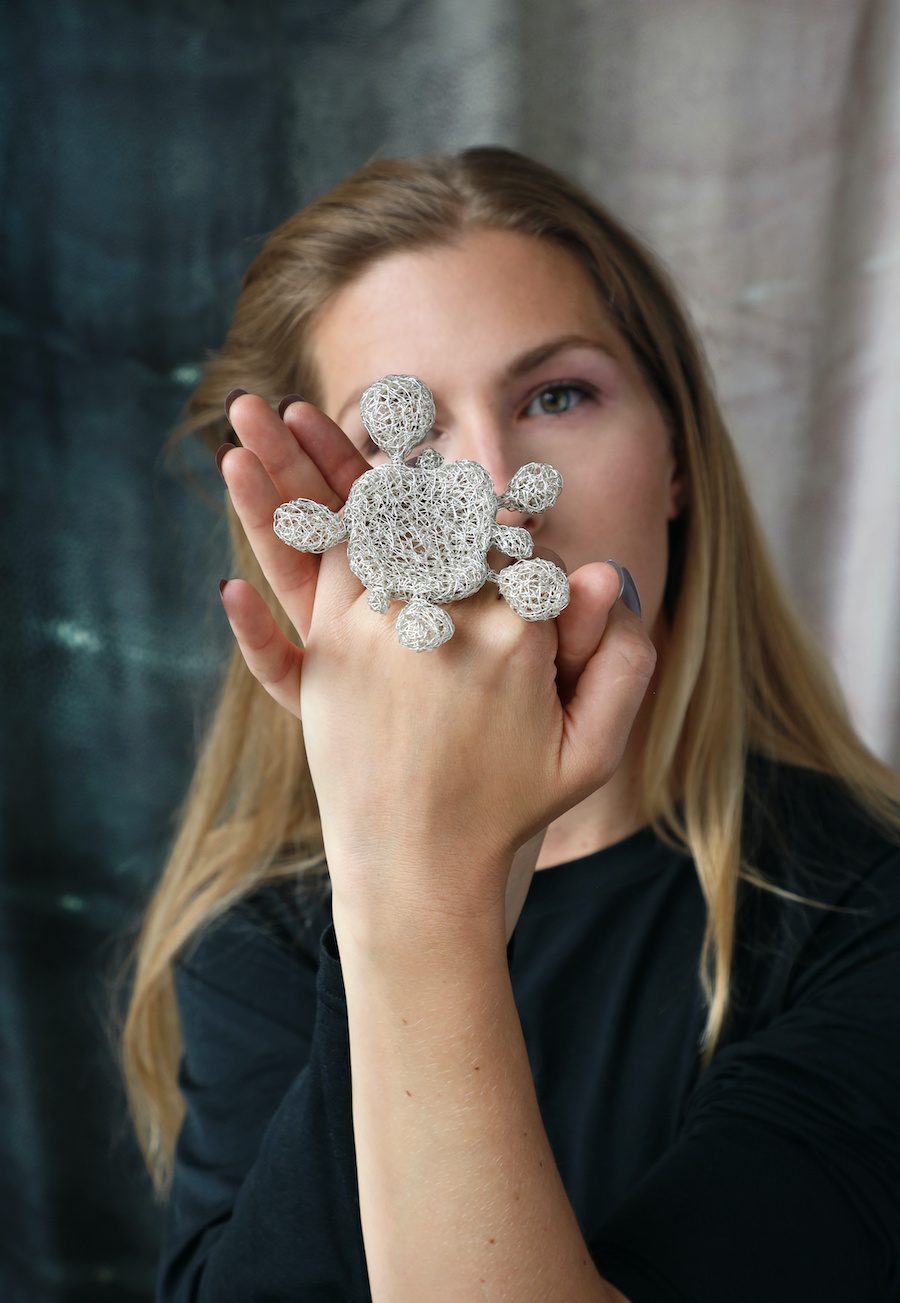
Many works end up in drawers because something isn’t working, to be picked up months or even a year later. Like for example, the now supersized necklace *All The Fish in the Sea* existed first of one a shape, made up of a silver shape in wirework, with it I wanted to express the overfishing in the seas. The statement I had in mind didn’t work out well, as I wanted it to be some kind of fishing nets, but the shape kept evolving, without any satisfaction. I spent weeks creating a second part, and it still wasn’t enough. When a year later a third part was added, followed by stones and pearls, and a message in a bottle saying ‘live more sustainable’. I also accepted the fact that it didn’t need to be a horrible piece dealing with such a heavy subject. This piece actually could be just beautiful. This is just one such example.
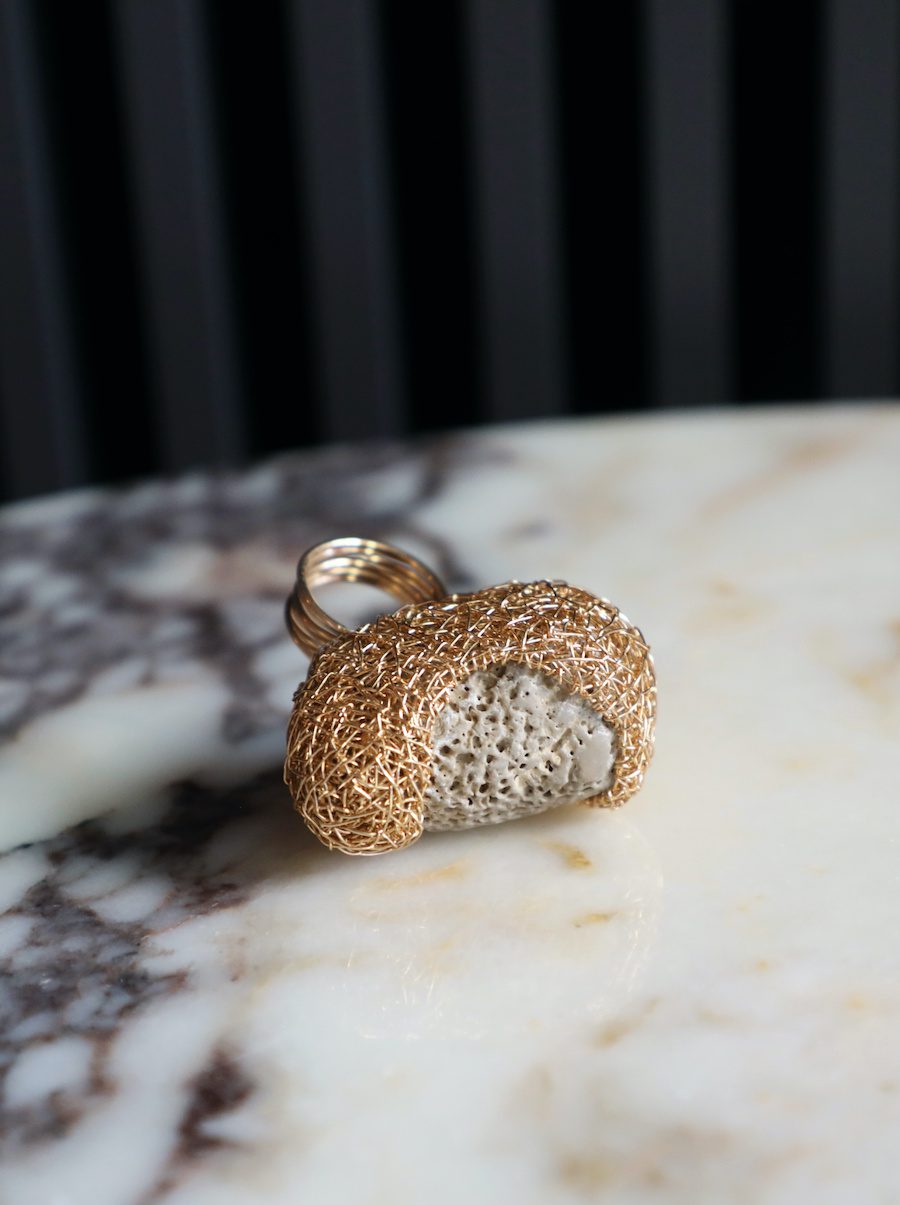
5. Congratulations on winning our prize Atelierul Award – The Iconic Ones. I love your creations. Could you please tell me what inspires you in the process of creating your jewellery pieces?
When I was asked to create something for the Venice Design Week, the theme spoke to me immediately, because I always have something to say.. and I would finally take the time to create a more cohesive series of jewels. For years I have been mostly working on my stone jewels, and in-between on some individual activist works. But I had a strong desire to create more series with a connected theme, to deepen a subject by using forms and shapes not related to things or objects encapsulated in them.
I had no idea for some time, and I truly suffered from ‘a writers block”. When my brother comes to visit, he often brings funny presents and this time it was slime, you know, the slimy child’s toy? But when holding it—even though I always want to keep the child within me alive—I didn’t find the same joy as before. It reminded me of ‘slimy politicians’ and false promises.
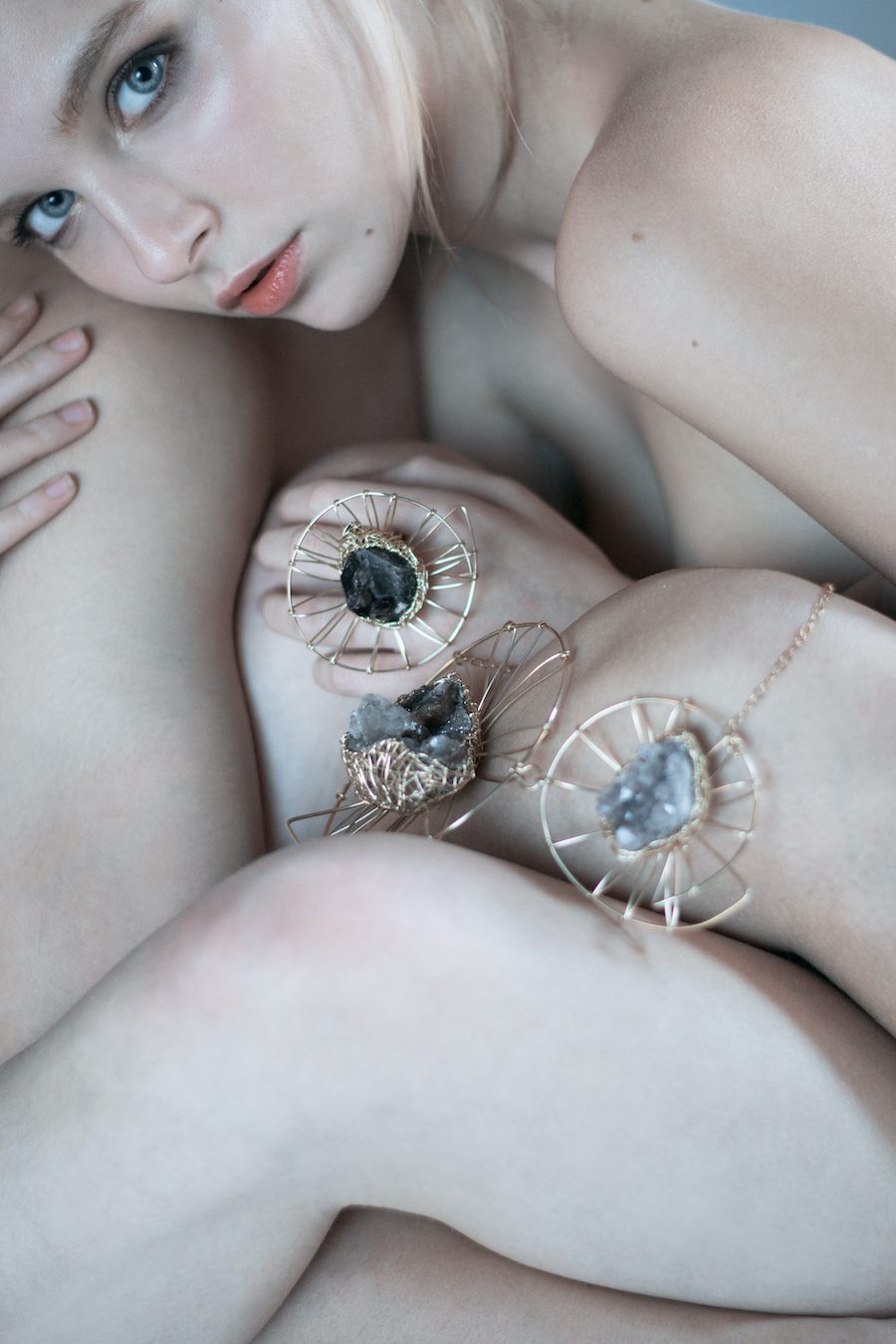
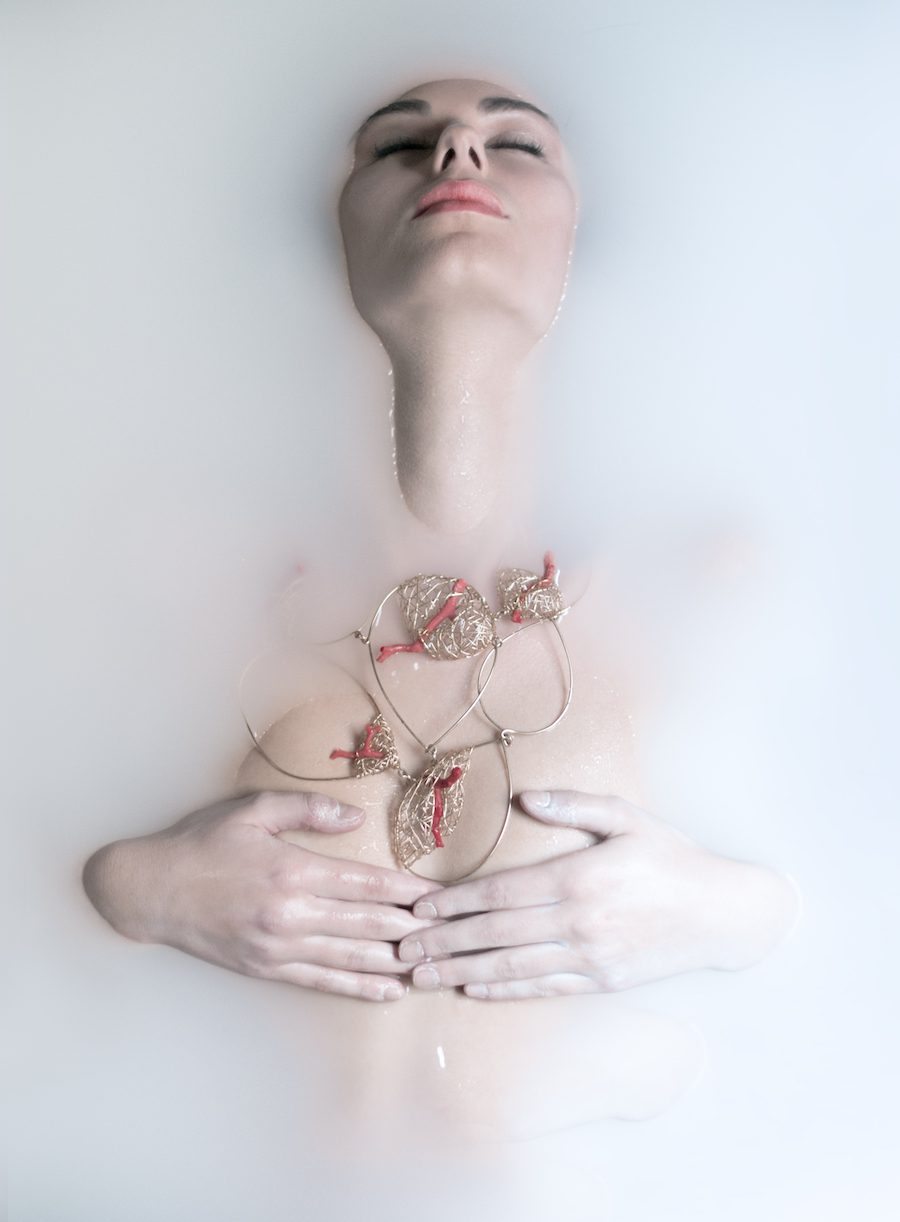
My subject became slime. I felt the need to create slimy forms and shapes to express my disgust with corruption.
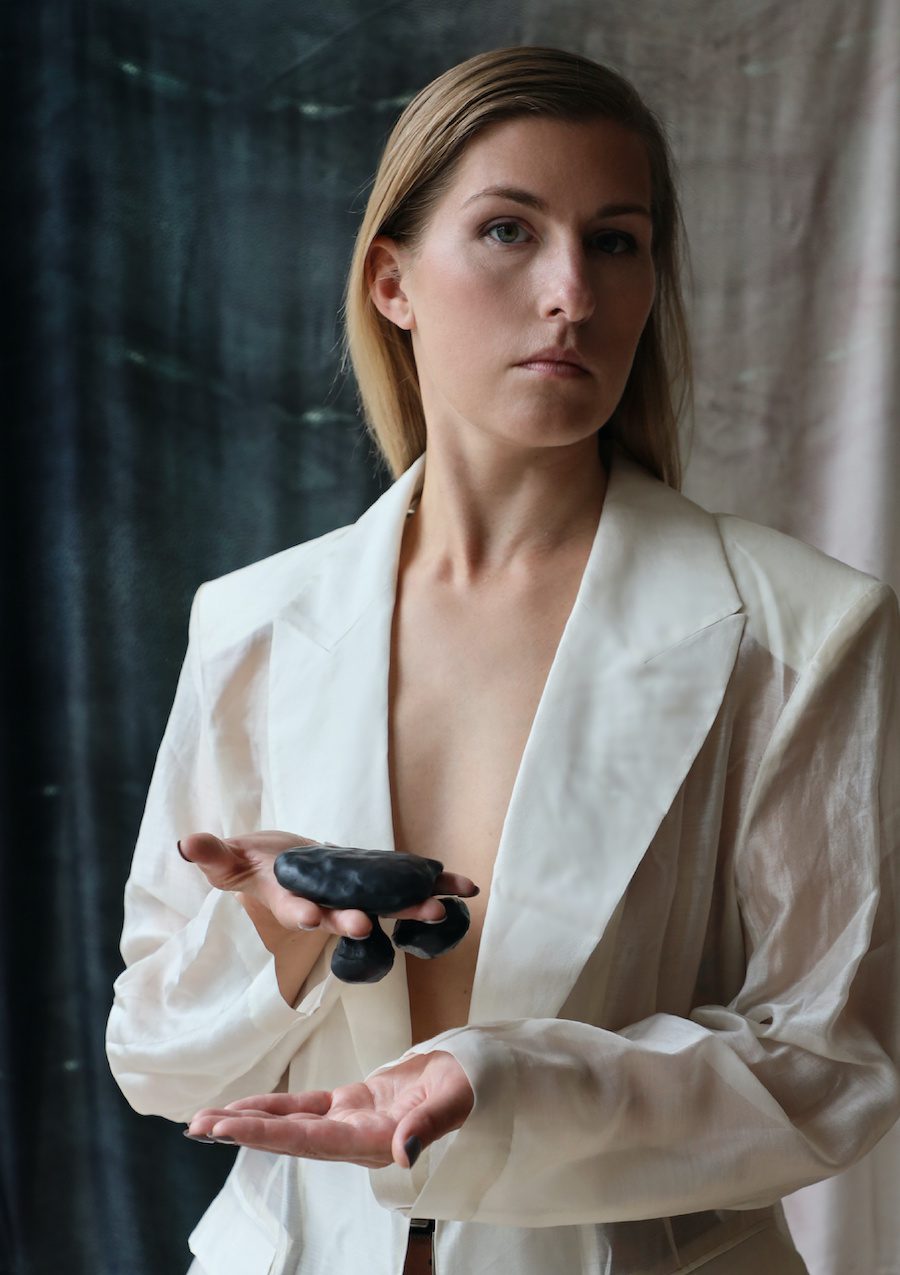
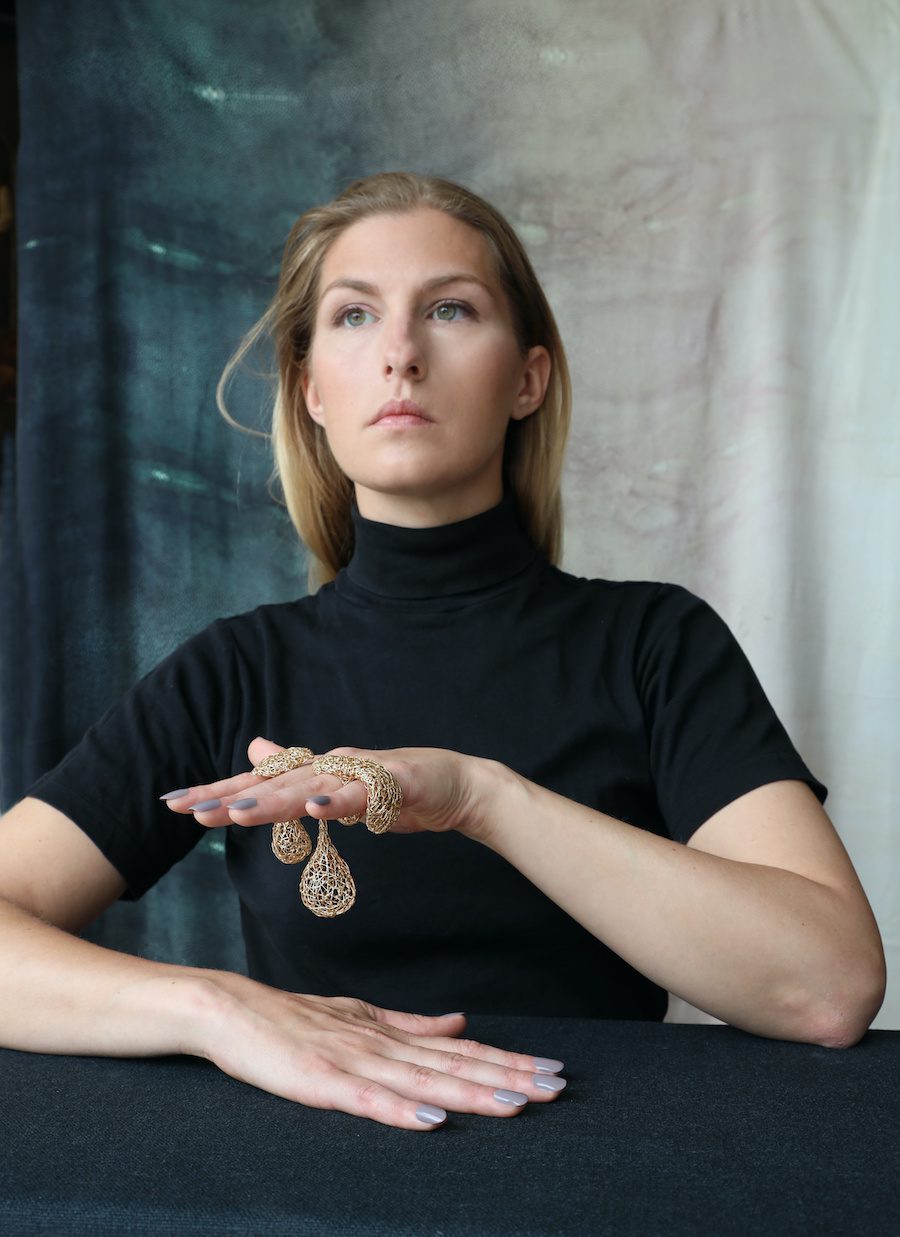
These works might be unwearable, but they were born out of a pure form of expression, and wearability wasn’t on my mind. Possibly the only jewel you can wear is the ring *Happily Ever After*, a smaller golden woven drop, resembling a pure drop of innocence before we realise as adults the corruption we actually live with. Other work that was connected to a theme, is the work I created for the exhibition ‘Living Trace’ in London at the end of November 2025. Seven rings where I’m dealing with my past, and my personal growth process.
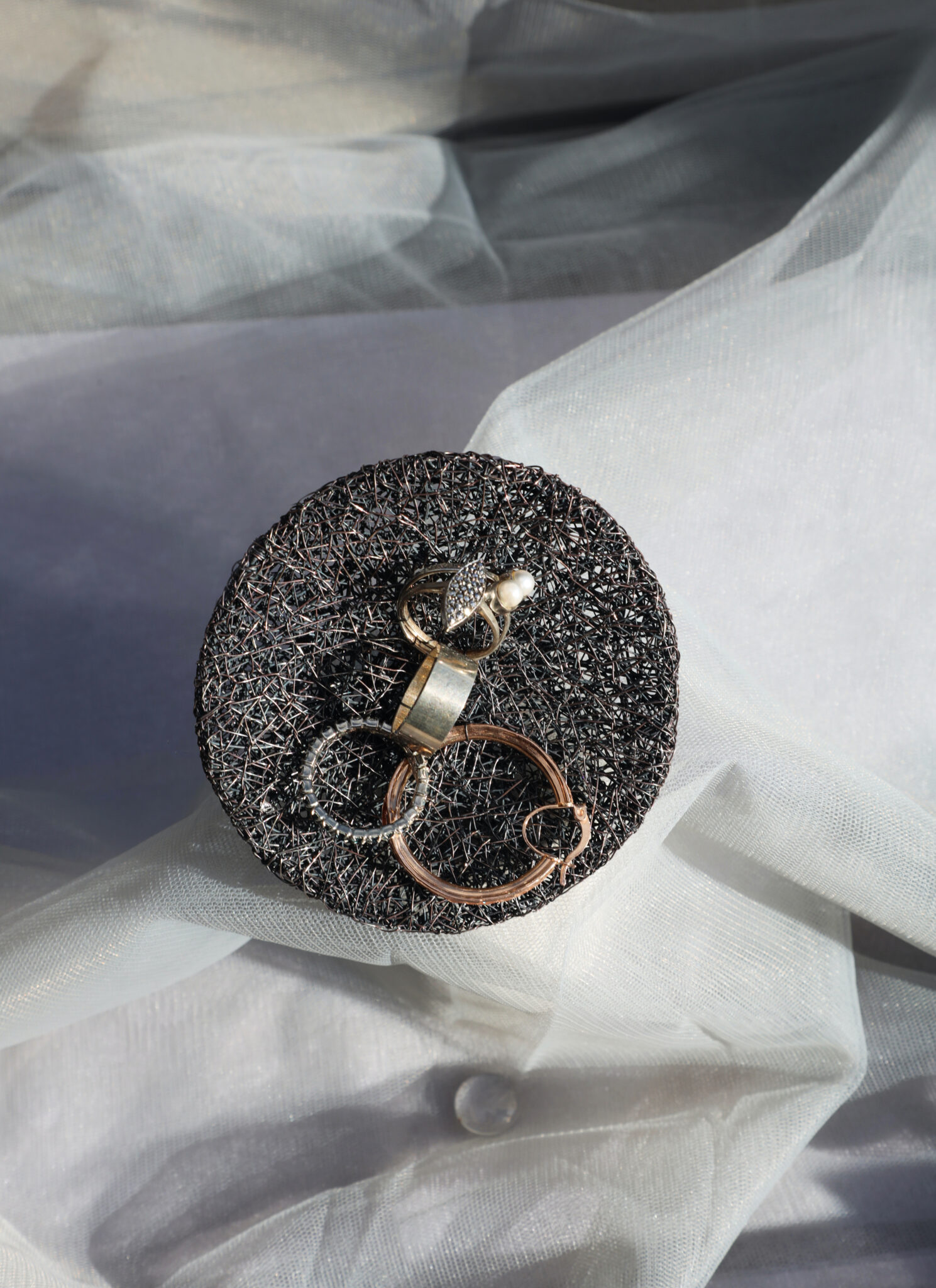
The works explained: In the first phase it is about Holding On. Three rings that deal with the past—jewels that I kept in drawers, stored in jewellery boxes or on saucers. Ring Preowned, Ring No Promise, and Ring Cocktail Time, come with jewels, that were given to me by family members, or a few that I found, nothing truly valuable and not to my liking either, but I just could not say goodbye to them for years, and they are now all ready to be shifted.
Then comes phase Fragility, where I’m dealing with the anxiety and letting go of the past. This ring is named Feel the Fear and Do It Anyway, and it’s my release.
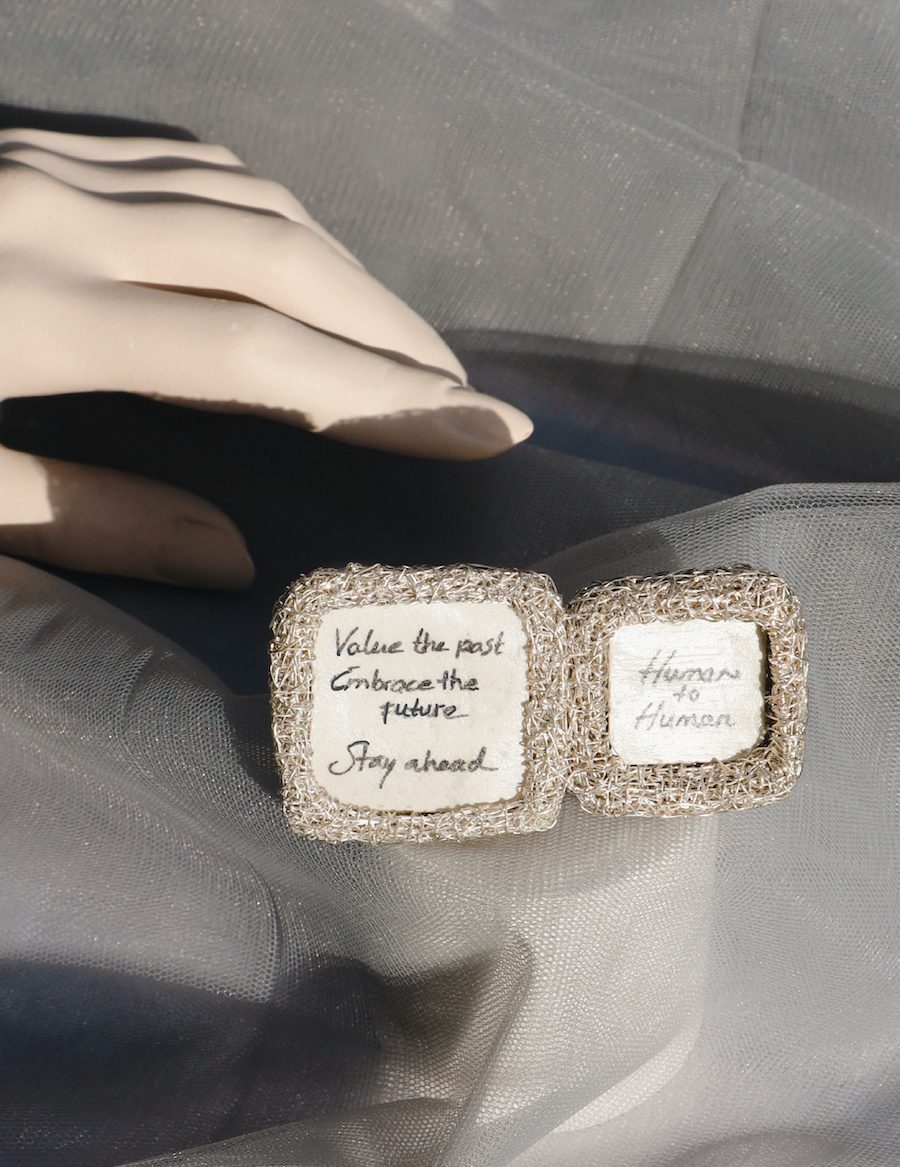
Phase three is about communicating and facing life. Two rings: Imagine comes with sticky notes, allowing you to create short messages to be shared, and Ring Just Saying equally deals with communication but in a different way, as you don’t need to hand out messages with love or hope, but this ring comes with different messages already on the jewel, and might attract people that like to communicate with you.
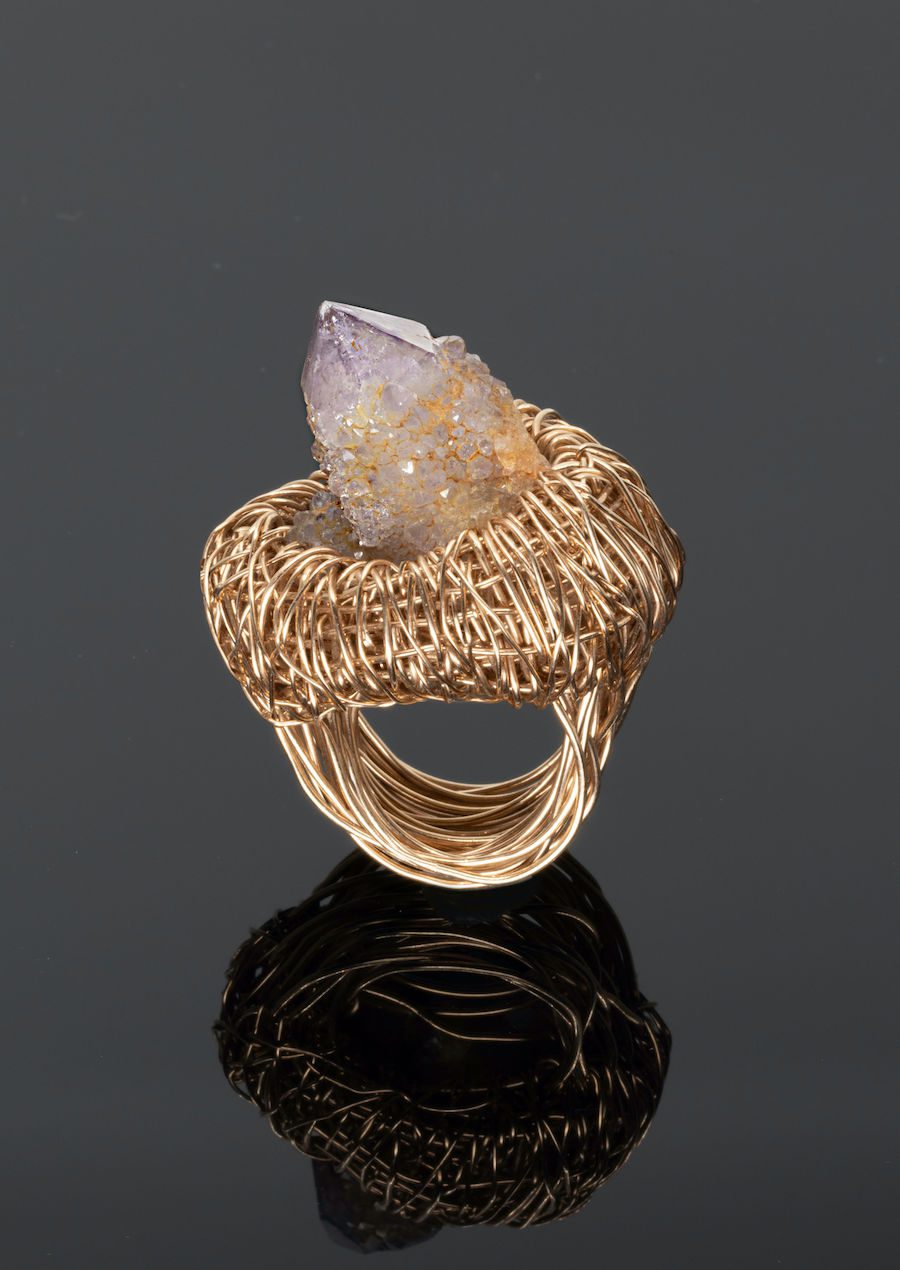
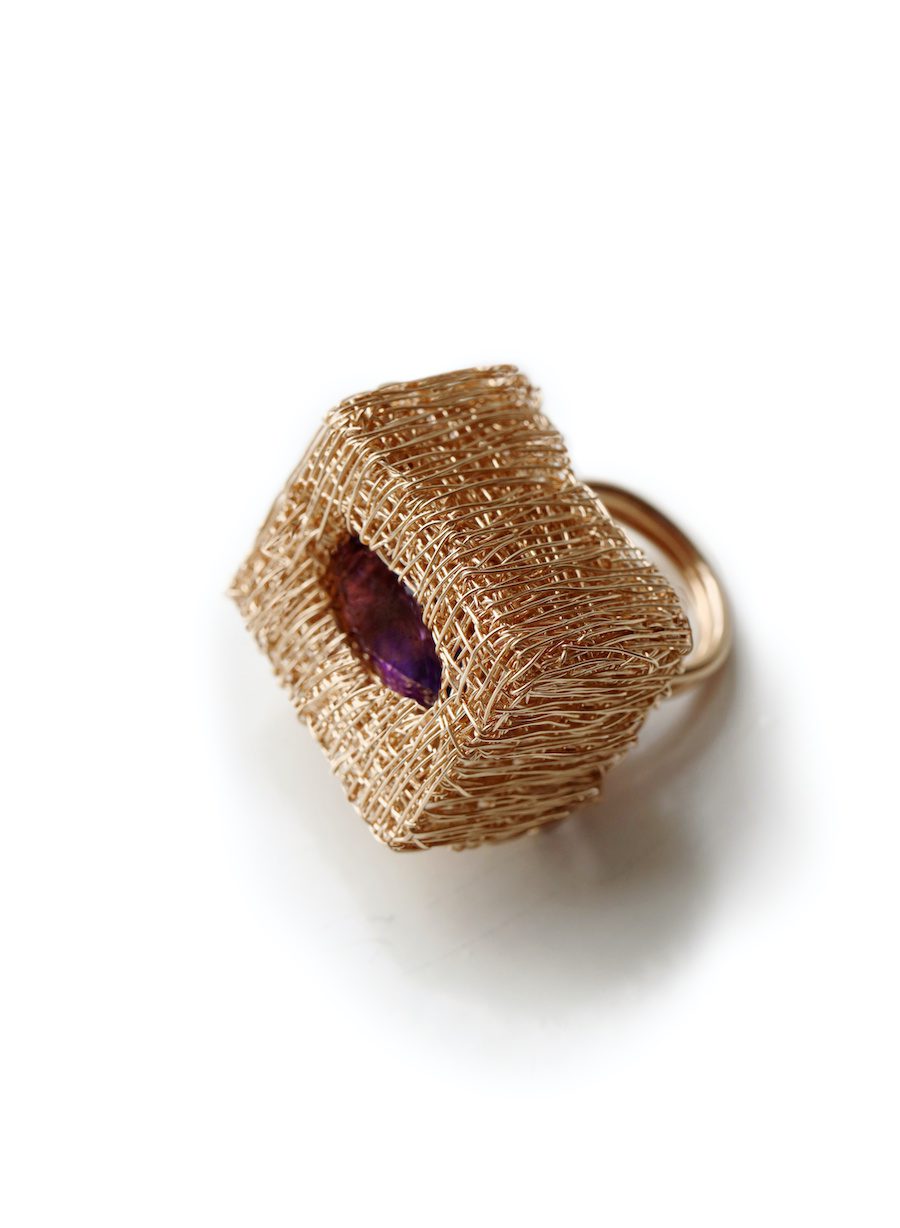
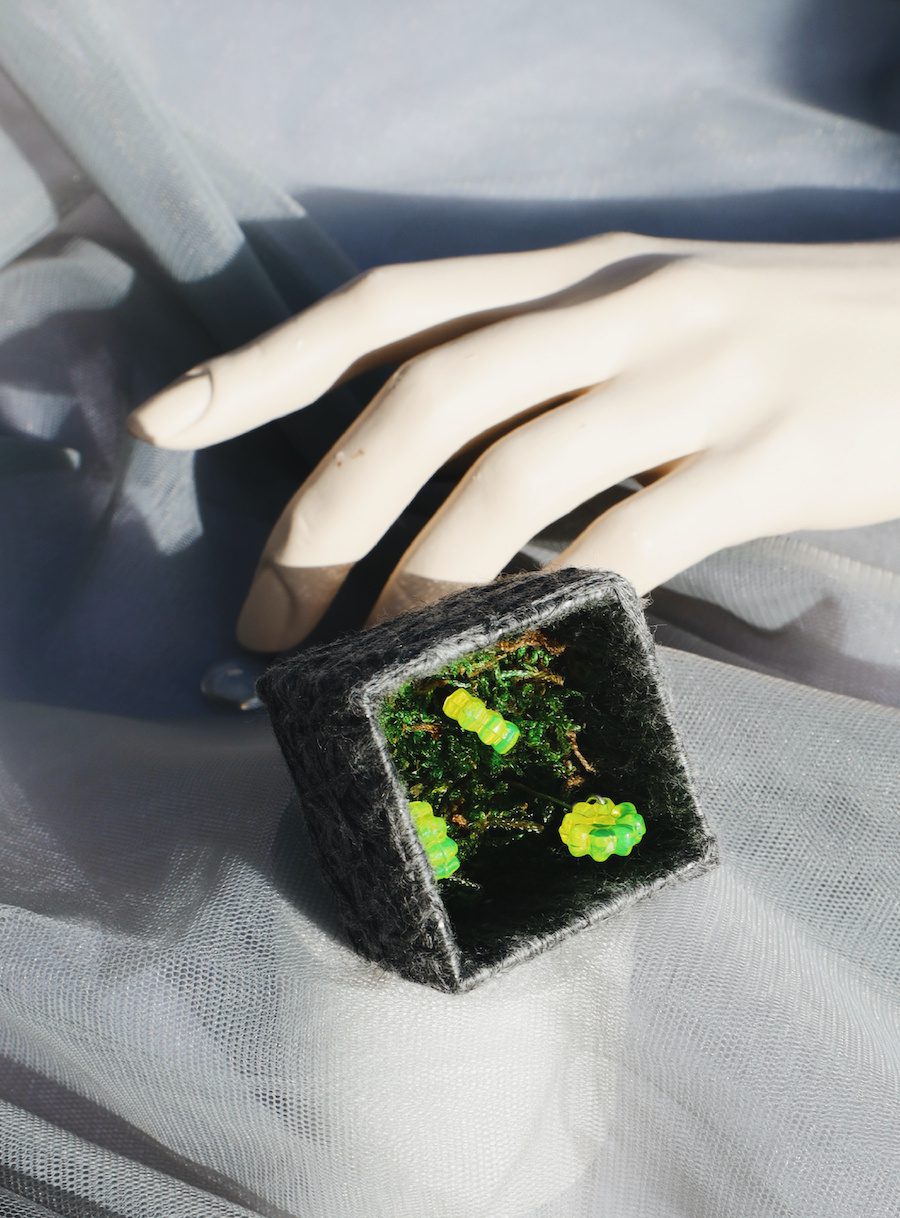
In the final phase, with Ring Genesis, I show hope and growth for our future, and we all get a chance to be part of it, because people are important. Ai and technology is great but never enough. Artisan processes will stay being important, mostly because they are part of a unique process which only humans can achieve. The box resembles a garden in which you plant a seed for growth.
6. How do you see your jewellery in an increasingly digitised society?
When the very first phone arrived about a hundred years ago, everyone feared its use and the same happened when a secretary was replaced by the computer and we all found a way to adapt to it, in the end. I have no problem with the digital age. YouTube videos with a certain knowledge are being spread, and more people are learning new things this way. The only problem is that many more people are doing the same thing at some point. This is where my own story comes in about having a love for originality in jewellery. Unique thoughts and creativity will remain, as there is a whole world happening in that small piece of true art being created. Something that will arise from your soul will always be valued by the right people. It’s only that digitalisation in itself also creates a mass market, and there won’t be a place for everyone.
I relate this process to the first industrial revolution, with the need for mass production because more people wanting the same thing led to more exclusivity in the end, and it enticed movements wanting to go back to the process of making. Fragility and strength are woven into everything I create with my hands and head.
7.Which do you like better, online sales or offline sales of your products?
I think offline sales, because you get to know the buyer, which is magical. Once I show a jewel, most of my clients become enthusiastic and want to buy more. When they know my jewels, they will buy them online easily, which is the nicest compliment.
8. What is the most important lesson you learned in your creative career? What was the best advice you received from somebody working in the creative and cultural industries? But also from a person that had a non-cultural profession?
It took me a long time to show my work online or in general, let alone the close-ups, as I have invented this technique myself, I was worried that people would copy my idea. When a friend in marketing said „if you never show anything, how would people know that you exist”? Well… first I wasn’t sure if I wanted my work to be seen, but this remark made me think as well, because yes I had started creating jewellery but I never thought about any next steps involved but you simply can’t keep creating without selling or to have contact with clients that also bring you something important; exchange of though and a form of respect.
The few lovely clients that had found my work, had pushed me into showing more, which was the biggest compliment ever. Next to this, good friends helped me with exposure, by word of mouth etc. as they though I deserved this, as they truly loved my work.
Only I needed my time. Most of my friends didn’t come from creative professions, and they saw my work simply as a product in need of marketing. That was a lot of pressure to deal with for me, but I learned that there is a truth in it maybe.
When I started to use social media I realised that photography was important. I tried many things, but I ended up becoming numb, as photographers were telling me that it had to be great or nothing at all, well, it was probably all about money. However, I needed photos to attract people who were looking for something beyond the usual, as my work clearly isn’t for wallflowers and so I tried many things over the years and it was an expensive learning curve. Today I do most shoots myself, with me behind the camera, with friends or anyone I think is suitable as a ‘model’. It taught me little by little that even with a shoot, I had to follow my heart and it’s a great way to just practise and find out what fits you only. Today I know what I want, and if I could afford a photographer again, it will be how I want it. Practice is key.
9. Do you have designers that you follow or admire?
An artist I’ve always admired is Alexander Calder, as he is a genius. What he did with just wire, the shapes he hammered, and the many clever solutions he came up with are mind boggling, and certainly for that time. I like anything by David Bielander, Benedict Haener, Giampaolo Babetto, Peter Machata, Eric Loubster, Tore Svensson, Giles Jonemann, just to name a few. These jewellery artists take jewellery to the next level, as in an art form. They either approach it with a clever sense of humour, with absurdity, or with intelligence. I’m in love with the work of Meghan Schmiedel. The clear but interesting shapes by Otto Künzli, Joo Hee Han’s eggshell jewels. I also like more classical work like Angela Cummings, which is very different and more elegant, but innovative for the time, or the beautiful and classical pieces of Belperron. There are too many to mention here.
10. How do you deal with plagiarism?
It happened a few times, and we took action, and my husband is good at such things. One time a website was removed because they literally copied everything by me. The website, the set up, the style of hands and positions, similar to mine, and rings were copied, and they were only set with different colour and type of stones. The jewels were obviously different, but they tried hard. This was some years ago.
As we shared the same website builder, we’ve written a tough letter with a lot of proof, and action was taken and thus the website was removed. What was interesting that their prices were higher than mine. I only found out because of the many, many hits coming from one account, so I researched this. I always expected this to happen, because of growing up in the jewellery business and having seen a lot of jewellery that look alike. It was also the reason why I never wanted to be a maker as many people scrupulously steal other peoples ideas, which is so disrespectful, and it has become a normality today.
I also find some platforms like Alibaba, or AliExpress, annoying, as other people are telling me that they have seen my work and my name on some of these websites, together with a ridiculous price. For example, you can find lots of work from other designers or makers as well, who never agreed on being featured there. Over time it has become such a nuisance that recently there is a way to have them takedown IP procedures.
11. What do you think is the greatest challenge for a jewellery designer right now?
For your work to be seen. If you’re spending time on your creations, you have less time to engage on social media or to be found, especially if you don’t want to show your face, like me, the growth stagnates. I find that people who are totally dedicated to that kind of engagement, with relatively mediocre work, are being seen. I just don’t have the energy. Although it might look like I’m spending a lot of time on social media, and I do spent time, but not all day as that will make anyone stressed out and it’s not worth it.
I did hire people in the past to help me, but I can only afford a few hours a week, which are never enough hours in the end, and when you are a niche jewellery maker it’s even harder to be seen. Photographers are expensive, and you only get a few photos for a relatively large amount. If you’re a small business owner with only one-off pieces, how are you able to afford this? So what today looks like a big effort today—I create many photos myself in a relatively short time span, and thus in a batch. Just when I feel like it, when there is time, and never under pressure.
If I do need more impressive photos, I’ll ask around for a friend photographer. This is one of those fields where you need a lot of love and passion for what you do, to keep it going, I mean the business side of things.
12. What advice can you give to a jewellery designer that is starting a creative business?
You need to put a lot of energy into the project, if you’re lucky you have friends that can help you at first, to get you going. Let them help you in field where you don’t feel comfortable.
If you want your work to be more original, you are part of a niche field, next to a need to fund yourself constantly. Passion and love for what you do, helps you to keep going. If you are lucky you’ll find a gallery who loves what you do and you can start building your name. But in the end also most galleries need to pay rent and personal. You need to prepare yourself for rejection, but it isn’t impossible to be picked up. And if your work is really good, recognition in some form will happen. If you want to make money, you should come up with more average work, just to fit the general taste and you need to sell your work to the right platforms to be picked up and focus on the process of selling and promoting yourself mostly.
Photo credit: Giuseppe Bini and Sheila Westera’s personal archive.
Thank you, Arte e Design Association and Eleonora Varotto, curator of “I Don’t Shine, I Have Something to Say,” for an awesome collaboration and for allowing Atelierul Magazine to award designers presented at Venice Design Week 2025.

